


A potential Super Niño is set to disrupt global markets, driving food inflation and infrastructure risk. Investors face rising exposure to climate shocks as extreme weather intensifies worldwide.
Summary
El Niño is becoming a systemic macroeconomic threat, disrupting weather patterns and global markets.
A potential “Super Niño” by 2026 could cause over 700 billion USD in damages.
Agricultural output shocks may drive global food prices up by up to 15%.
Energy systems, especially hydro-dependent regions, face significant operational risks.
Investors must adapt portfolios to increasing climate-driven volatility.
The systemic impact of El Niño on global markets
The El Niño-Southern Oscillation (ENSO) represents an accelerating systemic crisis for global infrastructure and asset allocation. Ocean warming anomalies disrupt primary jet streams, trigger severe supply chain volatility, and drive significant asset repricing. Understanding this macroeconomic framework allows market participants to effectively insulate their portfolios from impending climate shocks.
Key takeaways
The combination of natural macroclimatic warming and anthropogenically driven record ocean temperatures is transforming ordinary seasonal fluctuations into systemic, multi-billion-dollar economic liabilities.
The current ENSO phase threatens to trigger over $100 billion in global structural damage.
Agricultural commodity prices face immediate inflationary pressures, rising by up to 9%.
Hydroelectric energy shortfalls present acute operational risks to regional industrial grids.
Ocean mechanisms and the Super Niño threshold
The tropical Pacific Ocean acts like a shifting thermodynamic reservoir governed by the Walker circulation, the overarching atmospheric system of equatorial trade winds and rising air. Under neutral conditions, these strong easterly winds steadily drive sun-warmed surface water westward toward Asia, fueling heavy rainfall in the western Pacific. This continuous conveyor system allows cold, nutrient-rich water from the deep ocean to rise along the South American coast via upwelling, anchoring global weather and marine productivity.
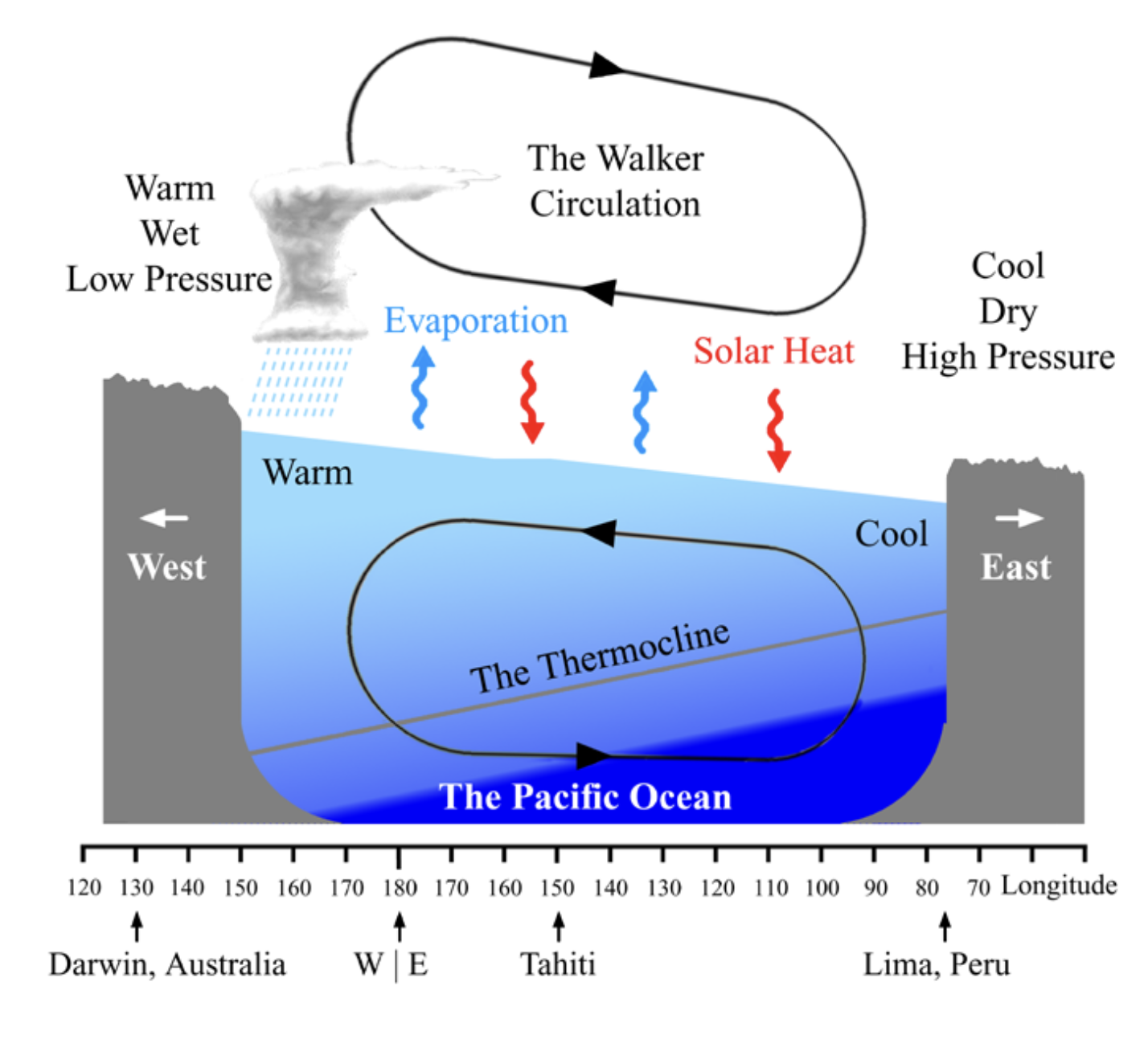 The Walker circulation is a Pacific atmospheric loop that fuels El Niño. (Source: Wikimedia Commons)
During an El Niño phase, these trade winds weaken significantly or reverse direction. The accumulated volume of warm water sloshes back eastward toward the Americas, capping the colder layers underneath. This massive release of thermal energy into the atmosphere alters global jet streams, triggering extreme weather deviations across multiple continents.
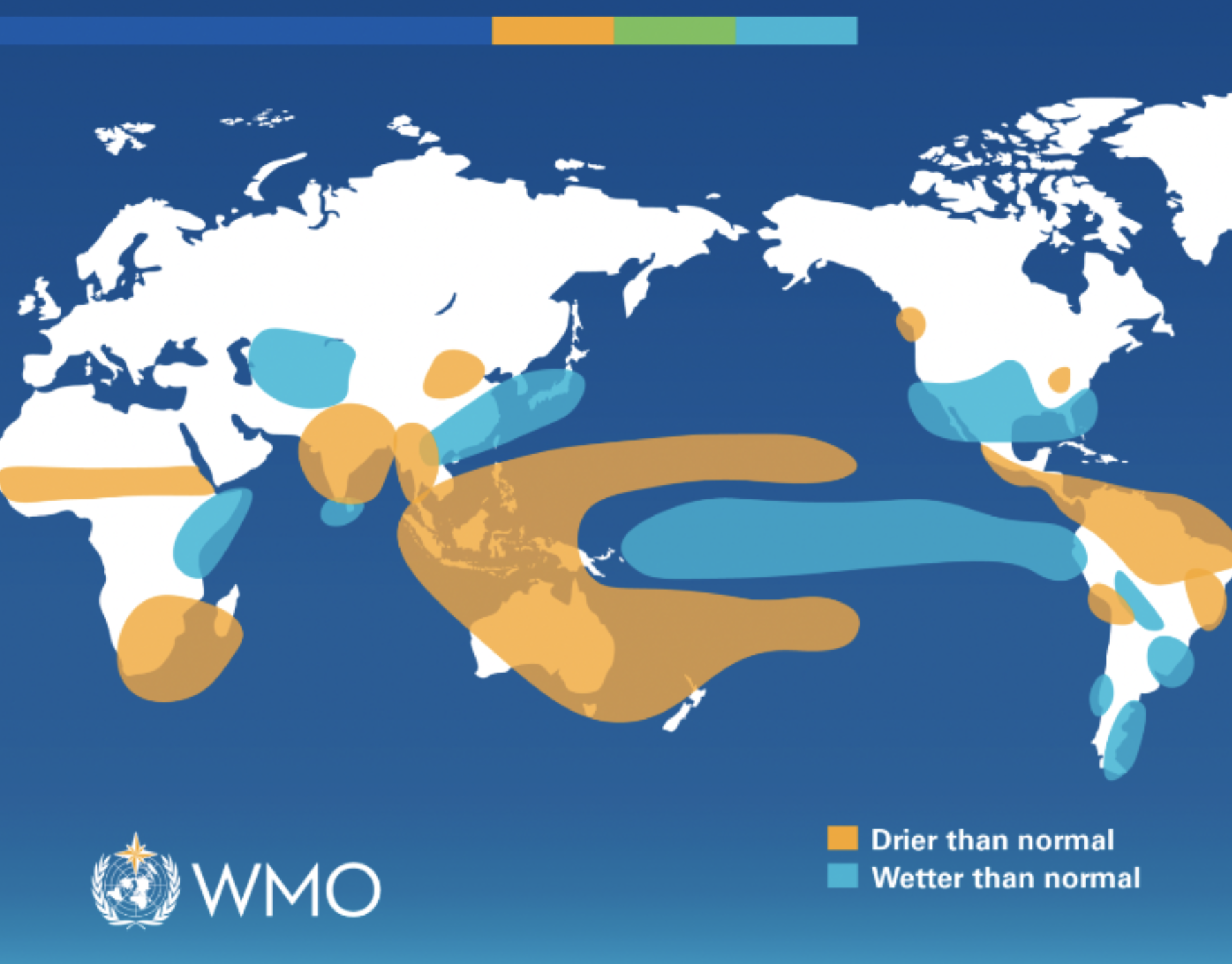 El Niño shifts rainfall patterns in different parts of the world. (Source: WMO)
A Super Niño occurs when sea surface temperature anomalies in the key equatorial tracking zone rise 2.0°C or more above the historical baseline average. It has the potential to rank among the most powerful El Niño events recorded since 1950.
These phenomena are incredibly rare, with only three such historic cycles observed in modern meteorological history (1982–83, 1997-98, and 2015-16). Even before the satellite era, extreme cycles produced catastrophic outcomes; the 1877-78 droughts across Asia, Africa, and Latin America directly contributed to the Global Famine of 1876-78, which resulted in an estimated 50 million deaths.
Current predictive models by WMO and US National Oceanic and Atmospheric Administration’s (NOAA) indicate a 81% probability of reaching these historic magnitudes between October –December 2026. Because this natural phase coincides with a baseline of record global ocean heat, meteorological agencies project an exceptionally volatile cycle.
We have already seen the compounding effects of this intersection: the last El Niño event (June 2023 to April 2024), when combined with baseline global warming, officially made 2024 the hottest year in recorded history.
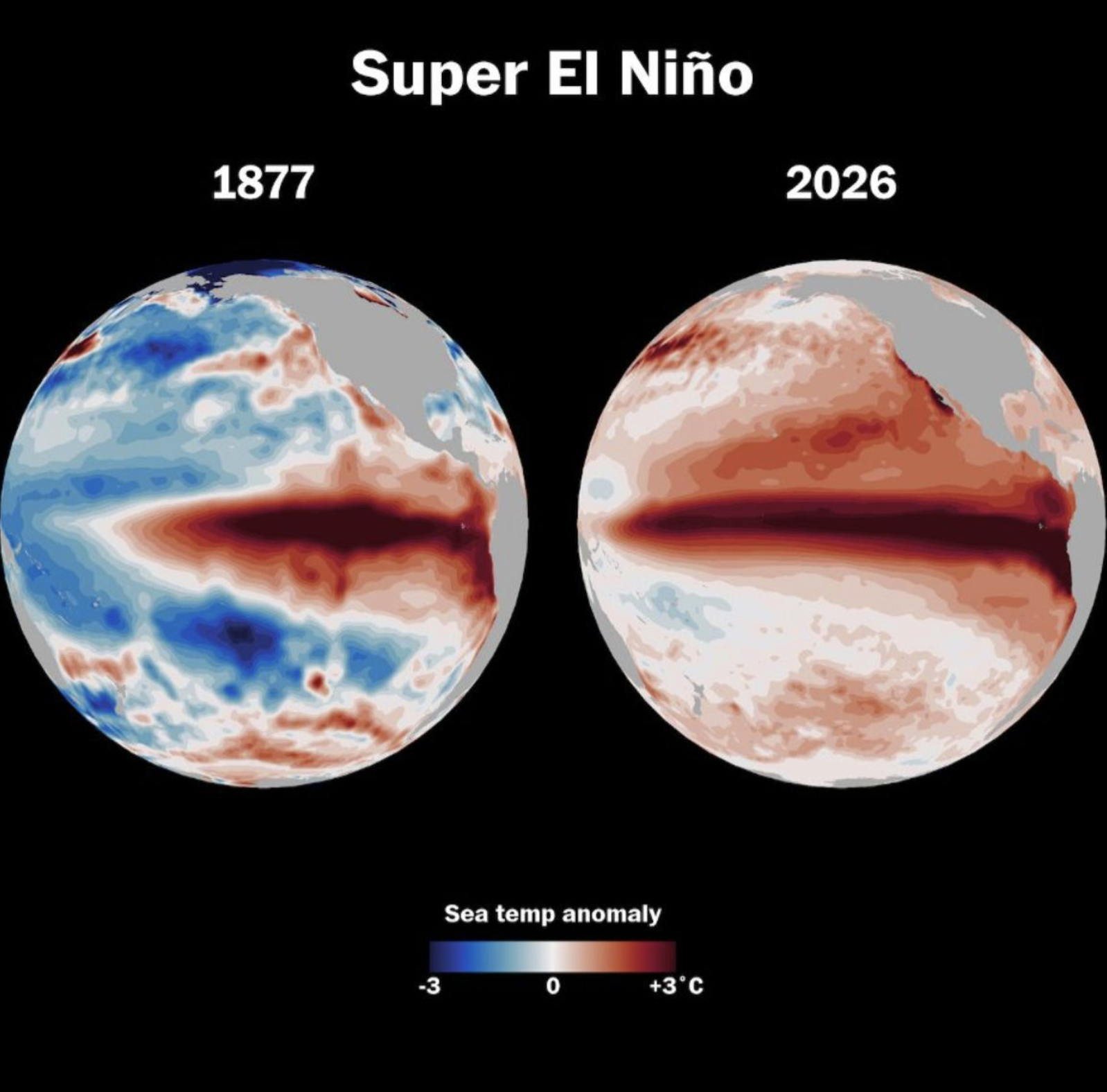 Sea surface temperature anomaly map of the historic 1877 "Super El Niño" with a projection for the year 2026. (Source: ECMWF/NOAA)
Macroeconomic shocks and agricultural scarcity
The disruption of the largest ocean basin on Earth creates a severe, asymmetric economic reality. Torrential rainfall triggers catastrophic flooding across the southern United States and the southern regions of South America. Concurrently, acute drought conditions, water shortages, and severe wildfire risks emerge across northern South America, Central America, the Caribbean, and Indonesia.
These compounding weather anomalies present an immediate risk to global food security and corporate supply chains. Extreme droughts severely stunt the production of critical global staples, causing massive shortages for rice, palm oil, sugar cane, soybeans, and corn.
The European Central Bank (Economic Bulletin 6/2023) models a strong El Niño driving global food commodity prices up 9% over two years. However, for a Super Niño, analysts view this as a conservative floor, projecting overall commodity spikes up to 15.8% and surges of 50–100%+ for vulnerable staples like rice, palm oil, sugar, and coffee.
Direct property and capital damage tied to recent extreme weather anomalies reached an estimated $103.3 billion according to the WMO. Furthermore, recent economic modeling indicates that an impending Super El Niño could drag down the global economy by almost $700 billion (or $686 billion) in contemporaneous losses and up to $3.1 trillion over the next five years. For institutional investors, these disruptions represent direct threats to asset valuations within agricultural hubs, logistics infrastructure, and insurance portfolios.
National flashpoint: Colombia's infrastructure risk
The macroclimatic crisis is unfolding with heightened velocity within specific regional corridors. The Instituto de Hidrología, Meteorología y Estudios Ambientales (IDEAM) officially confirmed that El Niño conditions are fully present across the atmosphere and territorial waters of Colombia.
The most recent data released by IDEAM highlights severe operational vulnerabilities for the national economy:
The phenomenon consolidated approximately three months earlier than initially projected by regional authorities.
The current bulletin gives over 97% probability of persistence into early 2027 and an 81% probability of "very strong" intensity during October–December 2026.
If fulfilled, this would place the current event among the most severe and intense climate anomalies recorded in Colombia since 1950. Because Colombia relies heavily on hydroelectricity for its domestic power supply, the sharp decline in precipitation directly threatens national energy grid stability.
Declining river flows trigger rapid drops in water reservoir levels, endangering both municipal drinking water networks and industrial power generation. Extended dry spells also elevate the risk of devastating forest fires, leading to air quality degradation near major urban centers.
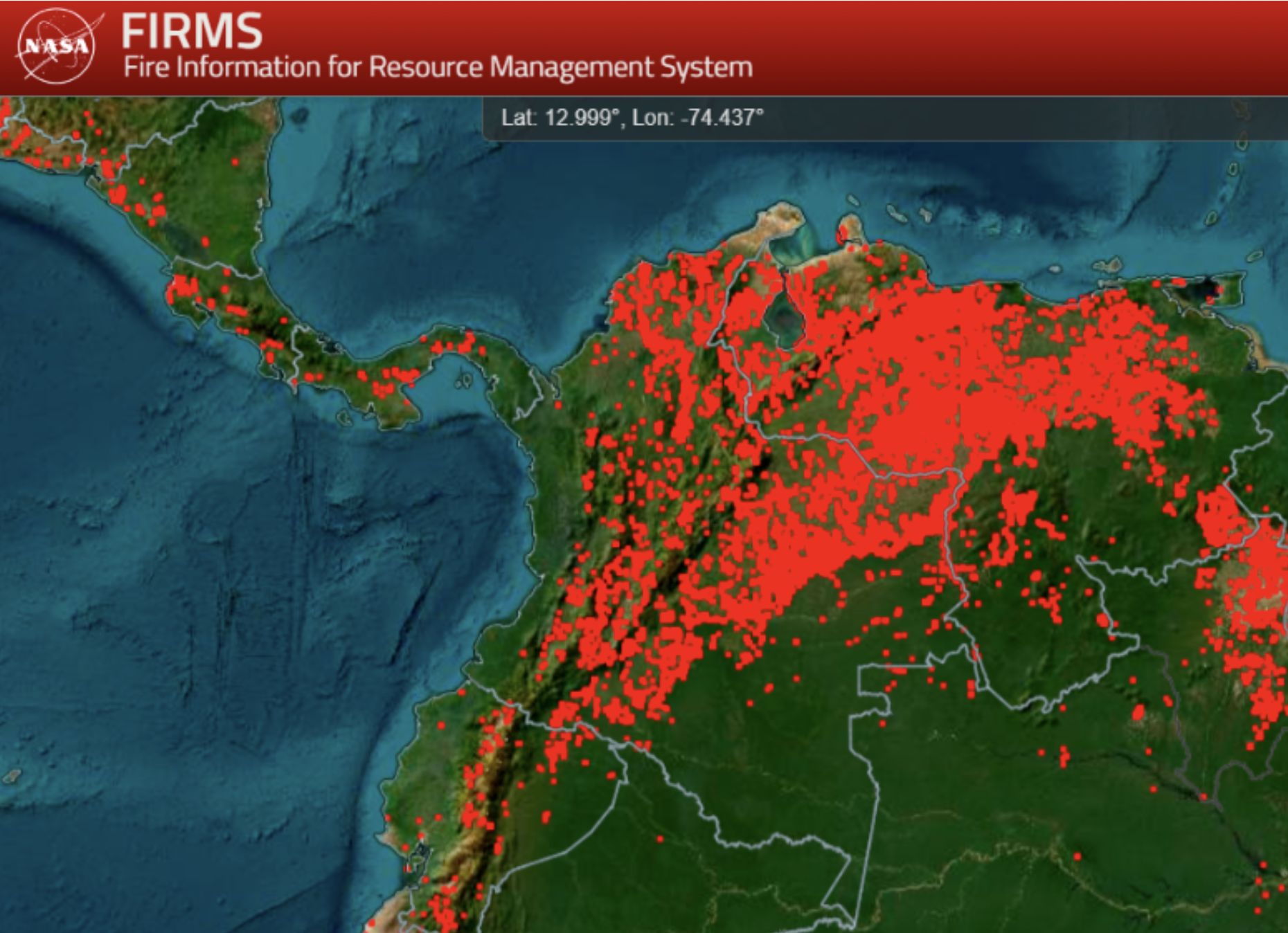 Satellite image of "Hotspots" or thermal anomalies in Colombia, detected by the FIRMS system (Source: NASA)
The cycle is fixed. The damage isn't.
El Niño cannot be prevented as it is a natural cycle. However, its economic toll can be managed and mitigated. Every degree variation of baseline ocean warming amplifies the risk, turning ordinary oscillations into systemic shocks. Climate finance can respond on three levels:
Risk transfer, through parametric insurance and catastrophe bonds covering ENSO-linked disasters;
Adaptation, through capital flowing into water, grid, and agricultural resilience; and
Mitigation, through carbon removal. Removals cannot stop the next El Niño but they address the warming baseline that amplifies each cycle. 2024 became the hottest year on record not because El Niño was unprecedented, but because it landed on top of record ocean heat.
For carbon markets, El Niño is also a stress test: droughts and fires threaten nature-based projects. This is why Planet2050 builds resilience by design through diversified portfolios across removal methods and geographies, backed by buffer mechanisms and carbon insurance..
A volatile climate is now the new default operating environment for every portfolio. The answer is not to hedge against the planet, but to invest in repairing it.
Bottom line
The impending Super Niño represents a predictable, systemic threat to global financial stability and regional resource security. Severe agricultural scarcity, soaring commodity costs, and critical energy grid vulnerabilities present multi-billion dollar risks to unhedged portfolios. Mitigating these cascading infrastructure failures requires immediate, data-driven governance and proactive capital reallocation.
_____
Stay ahead of the market
Read more on climate adaptation finance: From paper commitments to climate risk reduction
Subscribe to our newsletter to receive exclusive deployment updates, regulatory insights, and climate asset opportunities straight to your inbox.