


In July 2026, the European Commission adopted the certification methodologies for carbon farming - another key activity type under the EU's Carbon Removals and Carbon Farming Regulation (CRCF).
What the CRCF is
For twenty years, carbon credits were certified by private standards. Quality varied. Buyers had no reliable way of knowing whether a tonne was really a tonne. Trust collapsed.
The CRCF (Regulation 2024/3012) is Europe's answer: the first government-backed, EU-wide standard defining what counts as a certified tonne of carbon removal.
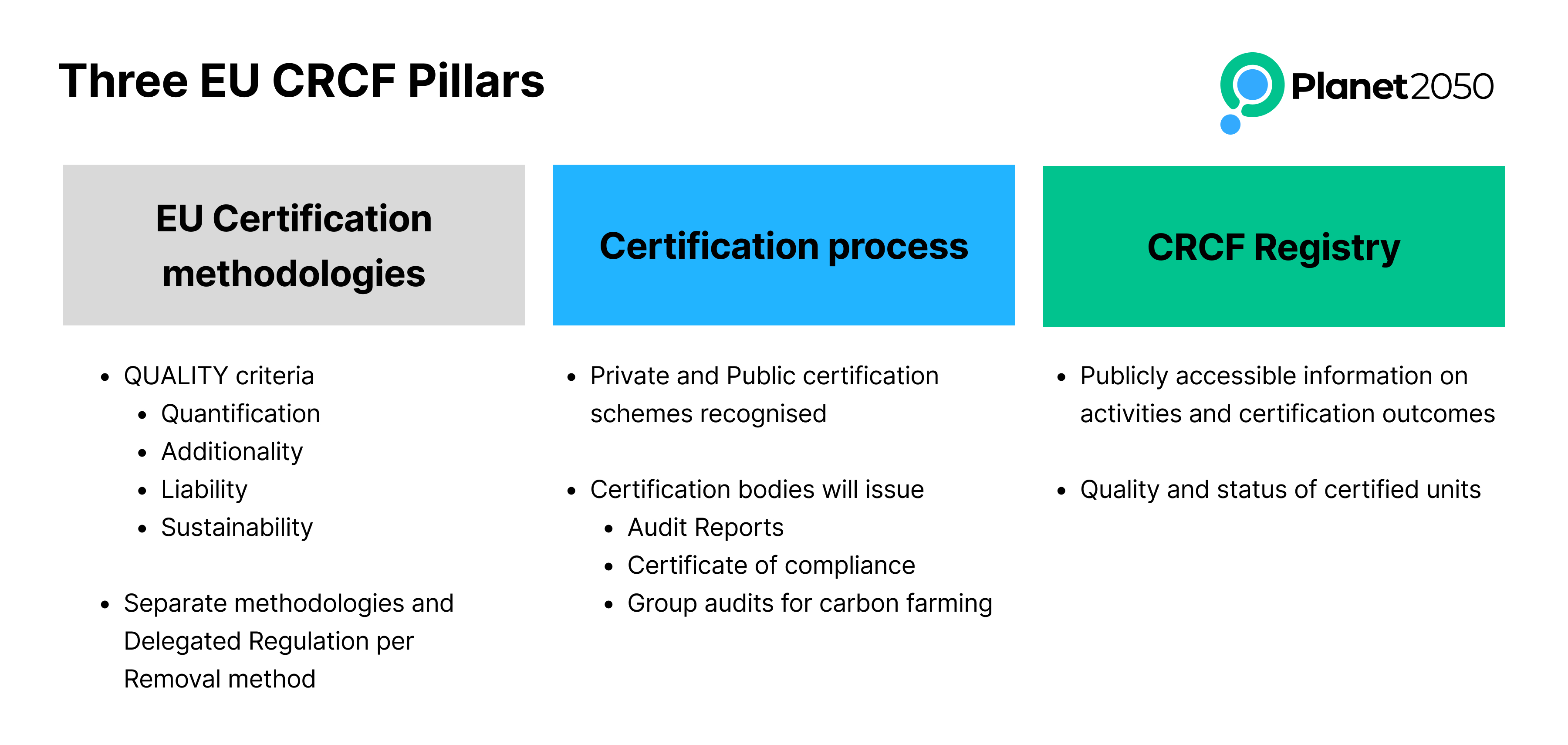
It rests on four pillars, known as QU.A.L.ITY:
Quantification - the tonne must be measured properly and conservatively. No optimistic maths.
Additionality - the carbon must not have been removed anyway. If the project happens without carbon revenue, it doesn't count.
Long-term storage - the carbon must stay put, and someone must be legally liable if it escapes.
Sustainability - no damage to biodiversity, water or soil in the process.
Four pillars, one purpose: make a tonne of carbon defensible.
Why this creates an asset class
Investors don't finance what they can't define.
An asset class needs three things: a definition, a registry, and enforceable rules.
The CRCF delivers all three - a common calculation method per technology, public registries (consolidated into one EU registry by 2028) that prevent double-counting, and independent accredited auditors backed by Commission-recognised schemes.
This is the same transition that turned electricity into a traded commodity: standardisation precedes investability. Once a tonne is defined identically for everyone, it can be priced, contracted forward, insured, financed and streamed. That is the moment carbon stops being a donation and becomes an asset.
The methodologies
The CRCF covers four activity types, and keeps their units separate - so a permanent removal is never confused with a temporary one.
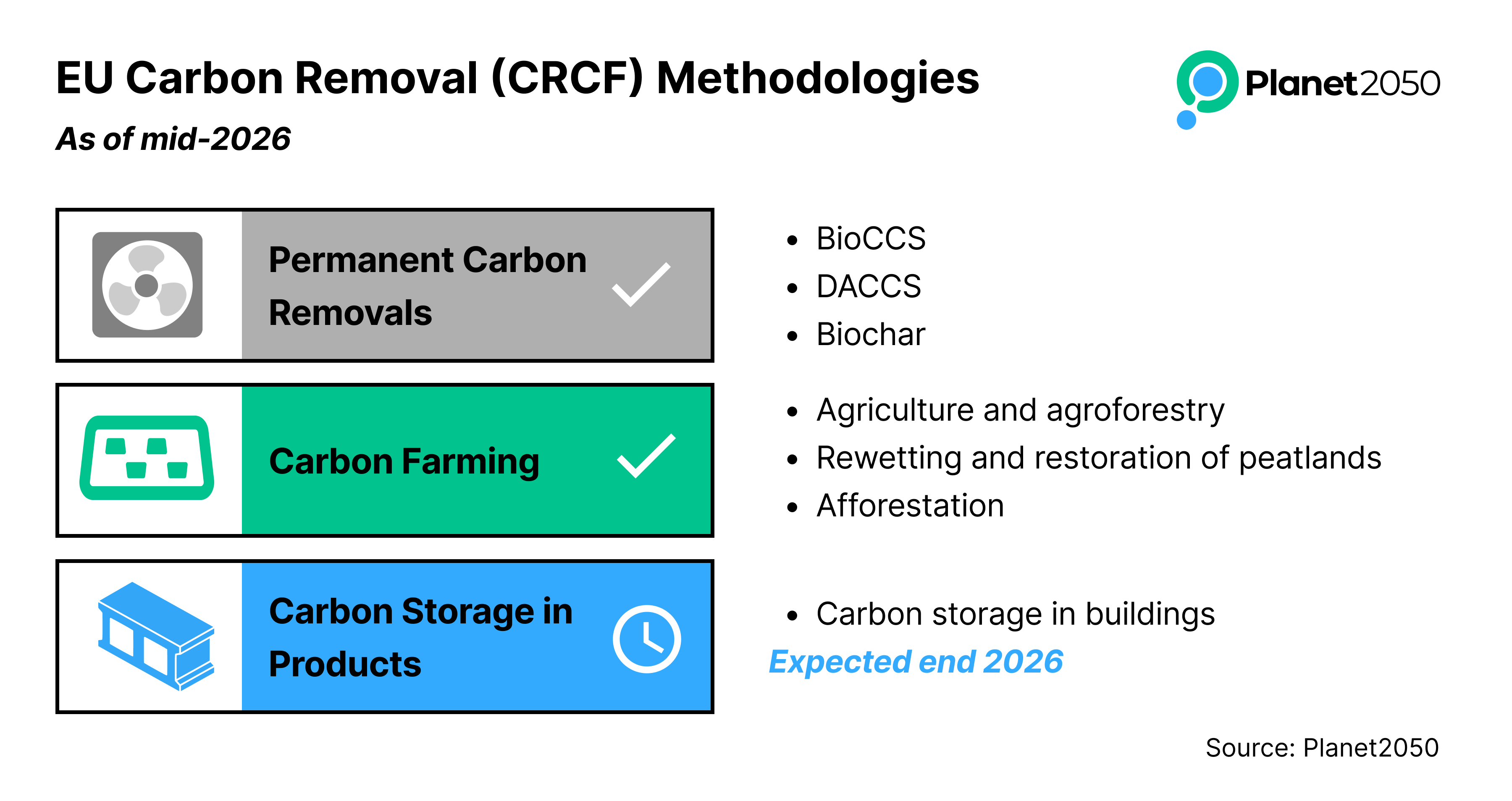
Permanent removals (approved February 2026) - carbon locked away for centuries:
DACCS - machines pullCO2 from the air; it is injected underground.
BioCCS - biomass used for energy, with theCO2 captured and stored underground.
Biochar (BCR) - biomass heated without oxygen into a stable carbon that resists decay for centuries.
Carbon farming (approved July 2026) - carbon stored in soils and trees, minimum five-year activity period:
Agriculture and agroforestry on mineral soils - cover crops, conservation tillage, hedgerows, trees in cropland and grazing land.
Peatland rewetting and restoration - re-flooding drained organic soils so they stop oxidising and releasing carbon.
Afforestation - new forest, with biodiversity safeguards.
Carbon storage in products (expected Q4 2026) - carbon held in bio-based construction materials, minimum 35-year permanence.
Soil emission reductions - cutting soil emissions, e.g. better fertiliser efficiency to reduce nitrous oxide.
Carbon farming: the size of the prize
Carbon farming pays farmers and foresters for results, not for effort. Instead of a subsidy for adopting a practice, they earn a certified, tradeable unit per verified tonne.
The scale is substantial:
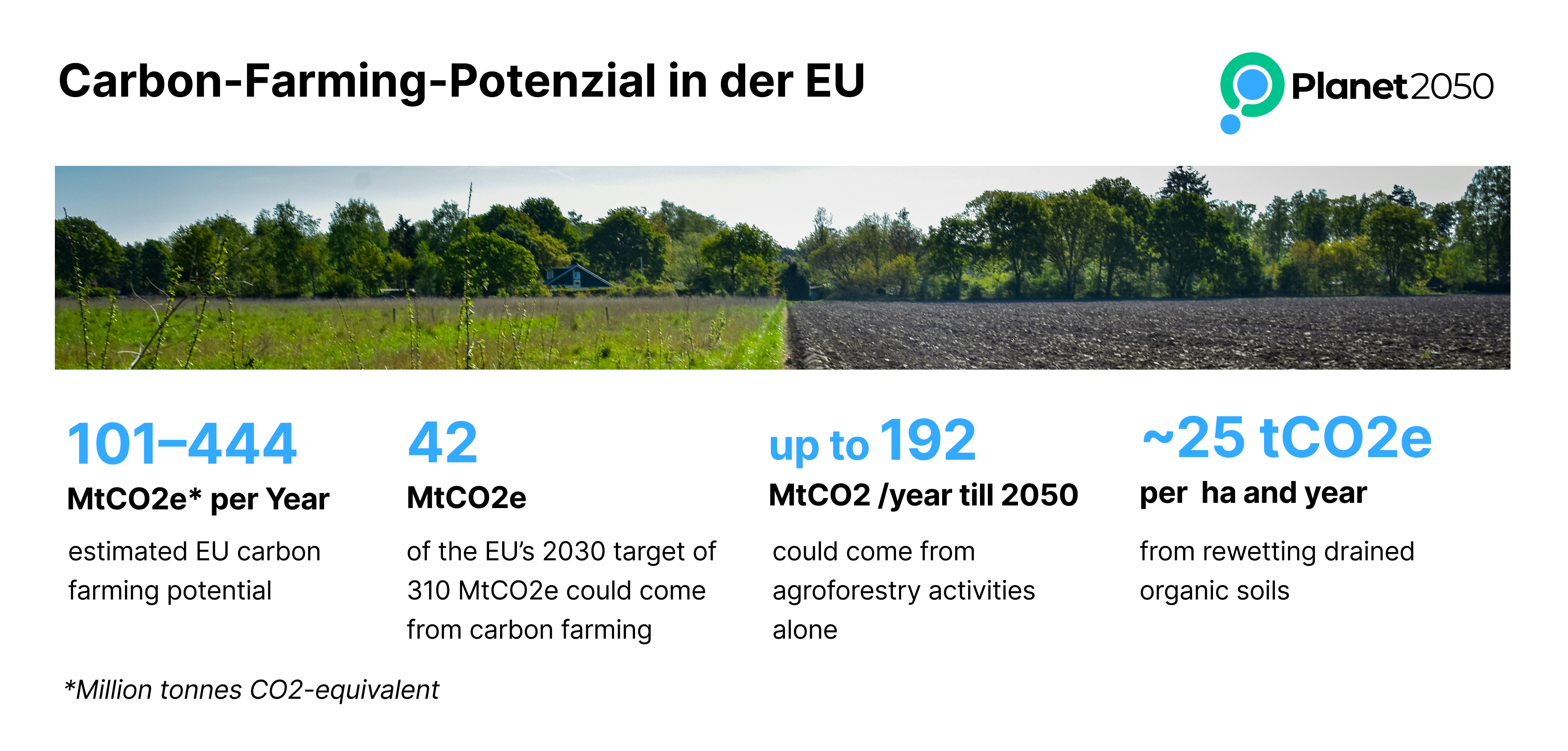
101–444 MtCO2e per year - estimated EU carbon farming potential, equal to 3–12% of total EU emissions (Van Hoof, S. Sustainability 2023, MDPI)
42 MtCO2e - the contribution expected from carbon farming toward the EU's 2030 target of 310 MtCO2e of net land-based removals (Journal of Environmental Management, December 2024^, ScienceDirect)
Up to 192 MtCO2 per year by 2050 - from agroforestry alone, at 1 million hectares established annually. The EU's entire current land sink is around 212 Mt. (Borovics, et al. Agroforest Syst 2025, Springer)
~25 tCO2e per hectare per year - from rewetting drained organic soils, versus 0.3–3.8 t/ha/yr for typical soil-carbon measures. Drained peatlands account for roughly 5% of total EU emissions.
Peatland restoration is one of the largest, most concentrated emission levers on the continent.
Why it matters for investors in the carbon markets
Our thesis has always been that the bottleneck in carbon markets is infrastructure. Projects that cannot be verified cannot be financed. Assets that cannot be defined cannot be traded.
The CRCF removes that bottleneck at the regulatory level:
Diligence gets cheaper. When every project is measured against the same EU methodology, evaluation stops being bespoke forensic work.
Quality becomes a spread. A CRCF-certified tonne carries regulatory backing an uncertified tonne does not. The market pays more for it.
New pipeline appears. Carbon farming brings millions of hectares of European farmland into the investable universe under a common rulebook. The Commission is already building an EU Buyers' Club to aggregate corporate demand, with a carbon farming track under discussion for early 2027.
Europe may have just done for carbon what regulators once did for securities: defined the product, licensed the auditors, built the registry. Capital follows standardisation.
What happens next
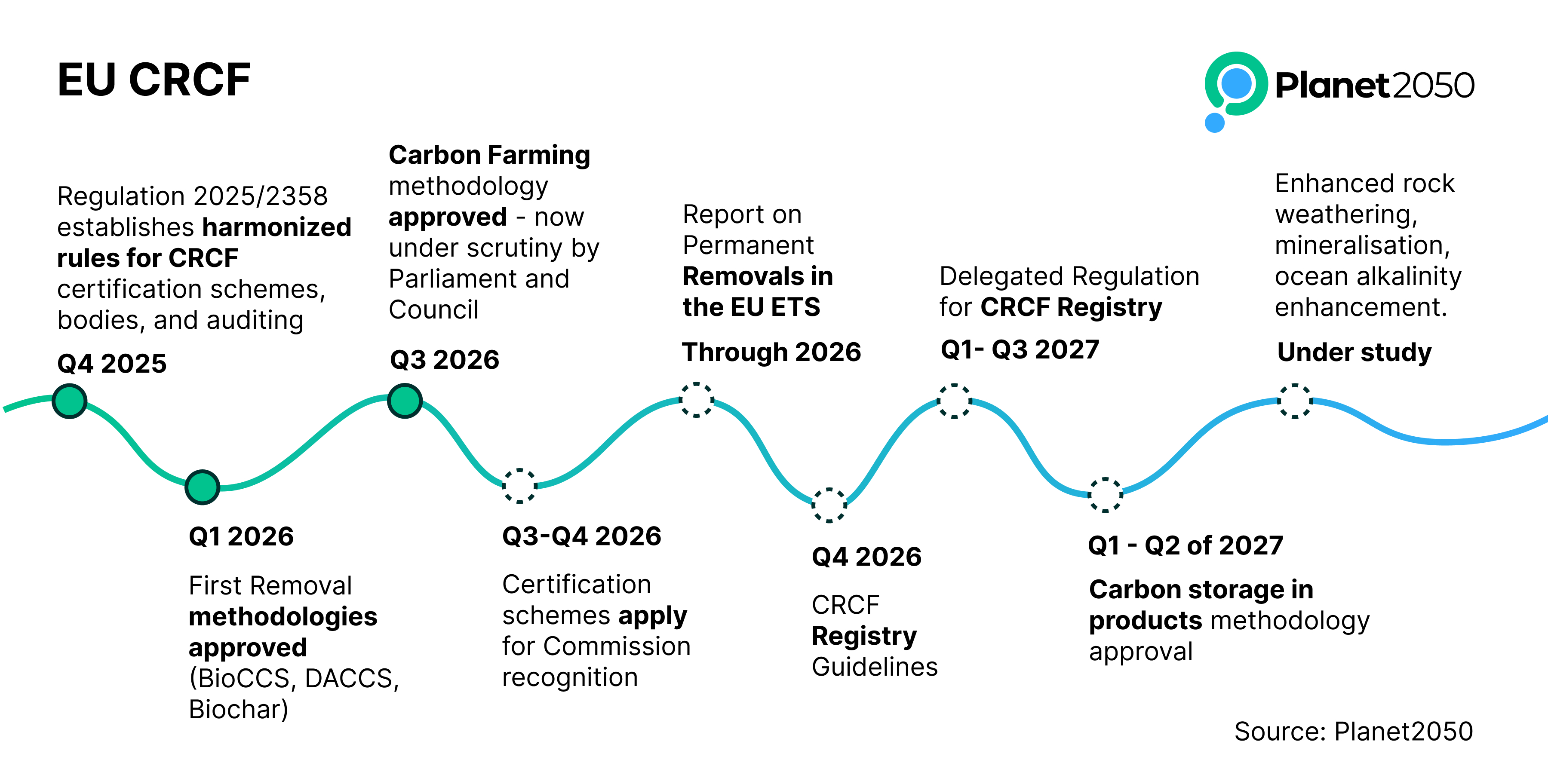
Now – Q3 2026 - the carbon farming act is under two-month scrutiny by Parliament and Council. Entry into force expected in Q3, absent objections.
Through 2026 - certification schemes apply for Commission recognition; first CRCF-certified projects expected this year.
Q4 2026 - methodology for carbon storage in bio-based construction products.
End 2026 - mandatory CRCF review: possible extension to livestock emissions, alignment with Article 6 of the Paris Agreement, and rules on using CRCF units in corporate climate claims.
2026 - Commission report on whether permanent removals can enter the EU Emissions Trading System.
By December 2028 - centralised EU registry operational.
Under study - enhanced rock weathering, mineralisation, ocean alkalinity enhancement.
The one to watch is the potential ETS integration.
The CRCF is voluntary today. If certified removals are ever admitted into Europe's compliance market, voluntary demand becomes regulated demand - and the floor beneath a certified tonne changes fundamentally.
_____
Stay ahead of the market
Read the EU page on EU CRCF - Carbon Farming
Go to our Investor page and signup for the alerts to receive listing updates.
Check our Other news on our Blog or subscribe to Planet2050 at to never miss the most important Carbon Market News.