


By Esther Val, LATAM Manager at Planet2050
Project highlights:
Cotierra is working with Colombia coffee farmers to turn residues into biochar
Mobile pyrolysis technology is embedded into global coffee supply chains alongside major partners like Nespresso, SENA, Swiss retailer Migros and more.
Biochar locks CO2 durably while restoring soil fertility and crop yields.
Cotierra uses offline-first mobile tools for transparent, traceable verification aligned with international carbon standards.
The project bridges carbon capital and rural economic resilience, delivering high-durability carbon removal alongside direct financial benefits for smallholders.
A deep dive into a local, decentralized biochar project
At Planet2050, our goal is to identify high-integrity, durable carbon removal projects that deliver real-world impact. To understand how decentralized carbon removal operates on the ground, we conducted a field deep dive into Cotierra, a Swiss climate-tech pioneer (founded 2023) operating across Colombia’s coffee regions.
Across global coffee supply chains, millions of tons of agricultural waste, specifically tree pruning wood and coffee pulp, are burned openly or left to decay. Open burning releases hazardous smoke and risks wildfires, while rotting coffee pulp emits greenhouse gases and takes up to two years to decompose.
Cotierra addresses this issue at the root by deploying mobile, on-farm technology that transforms coffee waste into biochar, a stable form of charcoal produced through pyrolysis that sequesters carbon for centuries while enriching degraded soils.
We show how Cotierra’s local, decentralized model combines durable carbon sequestration, immediate soil restoration, and direct financial payouts for coffee-farming families.
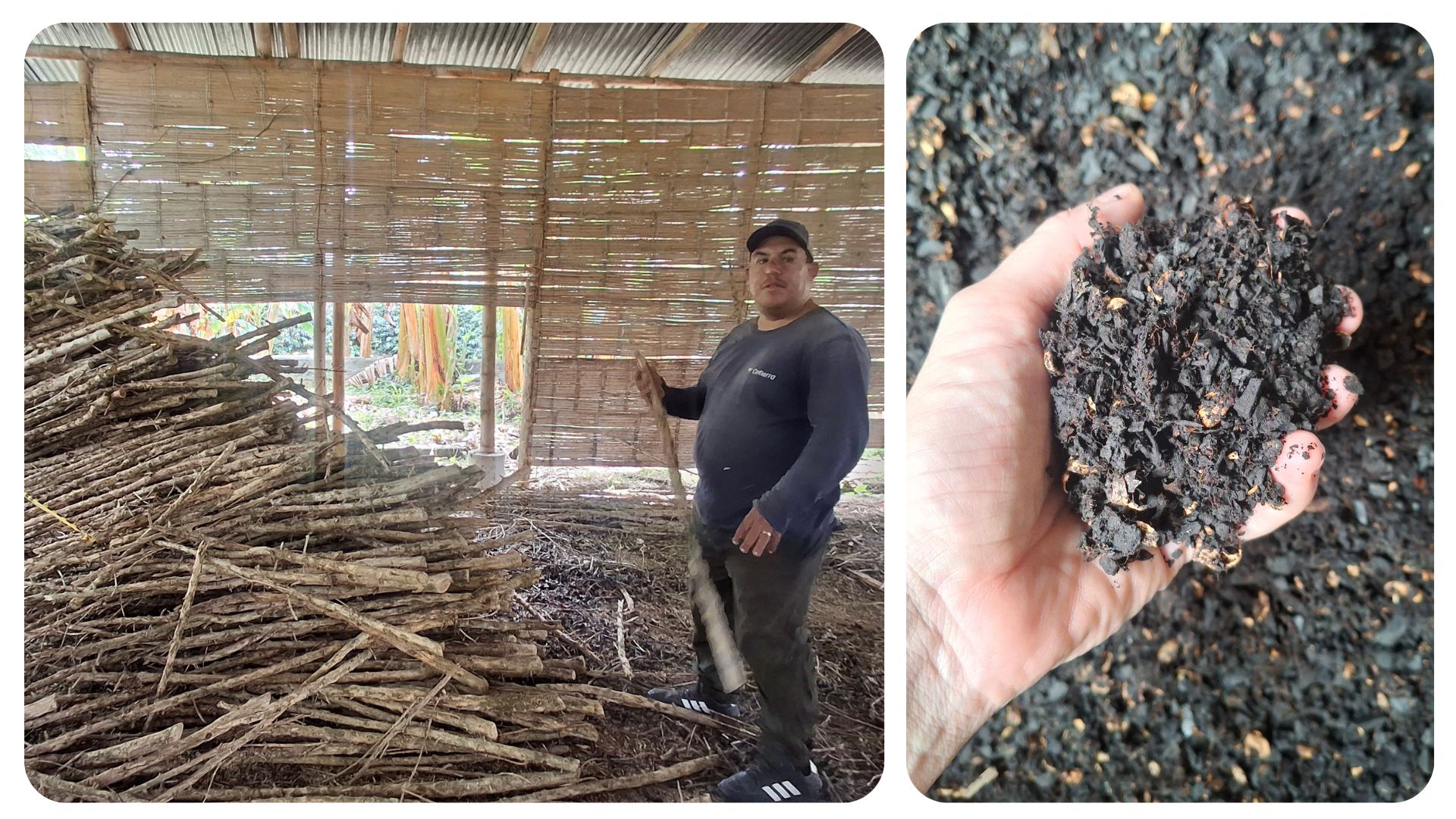 From coffee prunings to a biochar-pulp mix. Photo: Planet2050
Climate technology designed for rugged farming landscapes
During our field visit near Manizales, Colombia, we witnessed firsthand how Cotierra adapts technology to steep, rugged mountain terrains.
Mobile pyrolytic reactors: Automated units with smart airflow management that maintain optimal pyrolysis temperatures (700°C–750°C). The team can disassemble a reactor on one farm, transport it down winding dirt roads, and reassemble it on a neighboring farm in under 3 hours using a mechanical pulley system.
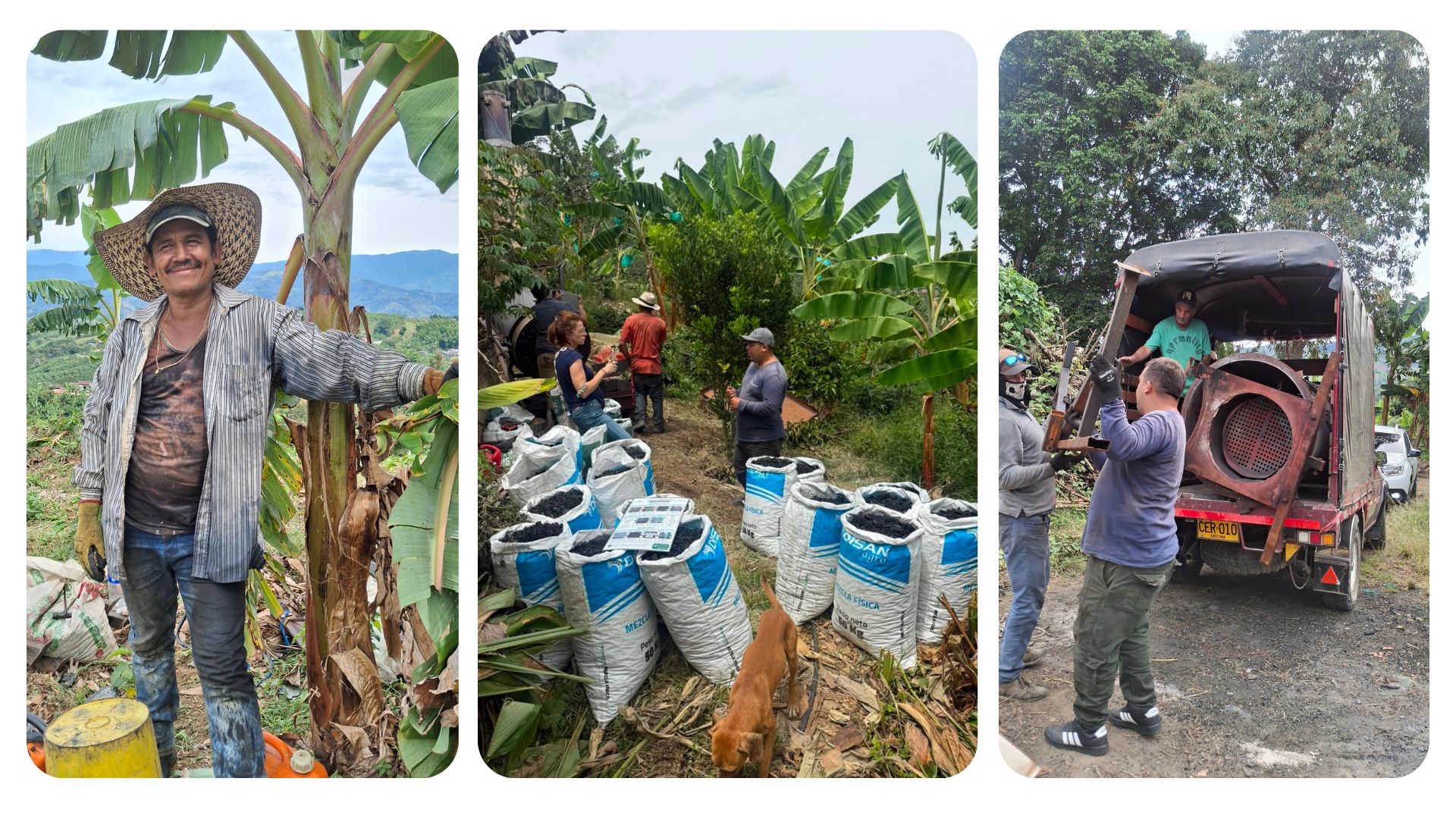 Local farm operator; Biochar bags; and the Cotierra team relocating a mobile pyrolysis kiln to a nearby farm for reassembly. Photo: Planet2050
Mobile kiln technologies suitable to Colombian terrain: Cotierra began with standard flame-curtain Kon-Tiki kilns - portable, near-smokeless, and light enough for steep mountain plots - and is gradually rolling out proprietary mobile versions with higher performance and integrated methane and temperature monitoring.
"We bring this technology directly to the countryside so farmers can transform coffee wood waste into soil gold. We improve soil fertility, clear field debris without smoke, and bring real technology to rural coffee communities."
— Liliana Arango, COO, Cotierra Colombia
Local operators highlight the ease and safety of the technology:
"Cotierra trainers taught me how everything worked and how to manage the app, and I picked it up right away. It takes about 20 minutes to fill with 300 to 400 logs, and the burn completes in under three hours. It's clean, safe, and doesn't get too hot while working."
— Local reactor operator
"Traditional open-air burning is very hard work: a pile can burn for 20 days or a month... Here with the kiln, it's just a few hours during the day and you're done. You see the progress right away, it clears out the brush, and there’s almost no smoke."
— Local coffee farmer
Generating direct economic impact and soil resilience for coffee farmers: In addition to cleaner air, farmers receive a direct incentive of 12,000 COP (~$3.87 USD as of Sept 2026) per 80-liter bag of biochar produced:
Daily earnings: With each burn generating 3 to 4 bags across 2 to 3 daily burns (totaling 6 to 12 bags daily), workers earn an additional 72,000 to 144,000 COP daily (~$23.23 to $46.45 USD).
Local context: In Colombia, where the monthly minimum wage is approximately ~1.3 million COP (~$419 USD), these payouts allow farm workers to double or triple their standard daily income during multi-week processing stints.
Beyond cash bonuses, co-composting biochar with coffee pulp yields immediate agronomic benefits:
"When coffee pulp decomposes alone, it loses nutrients and volume as water and gases evaporate. When we mix in biochar, it acts like a sponge holding onto the nutrients and keeping them in the soil. A single application of biochar can repair and nourish the soil for 20 years."
— Fabio Andrés, Environmental Technician, SENA (Colombia’s national technical learning service)
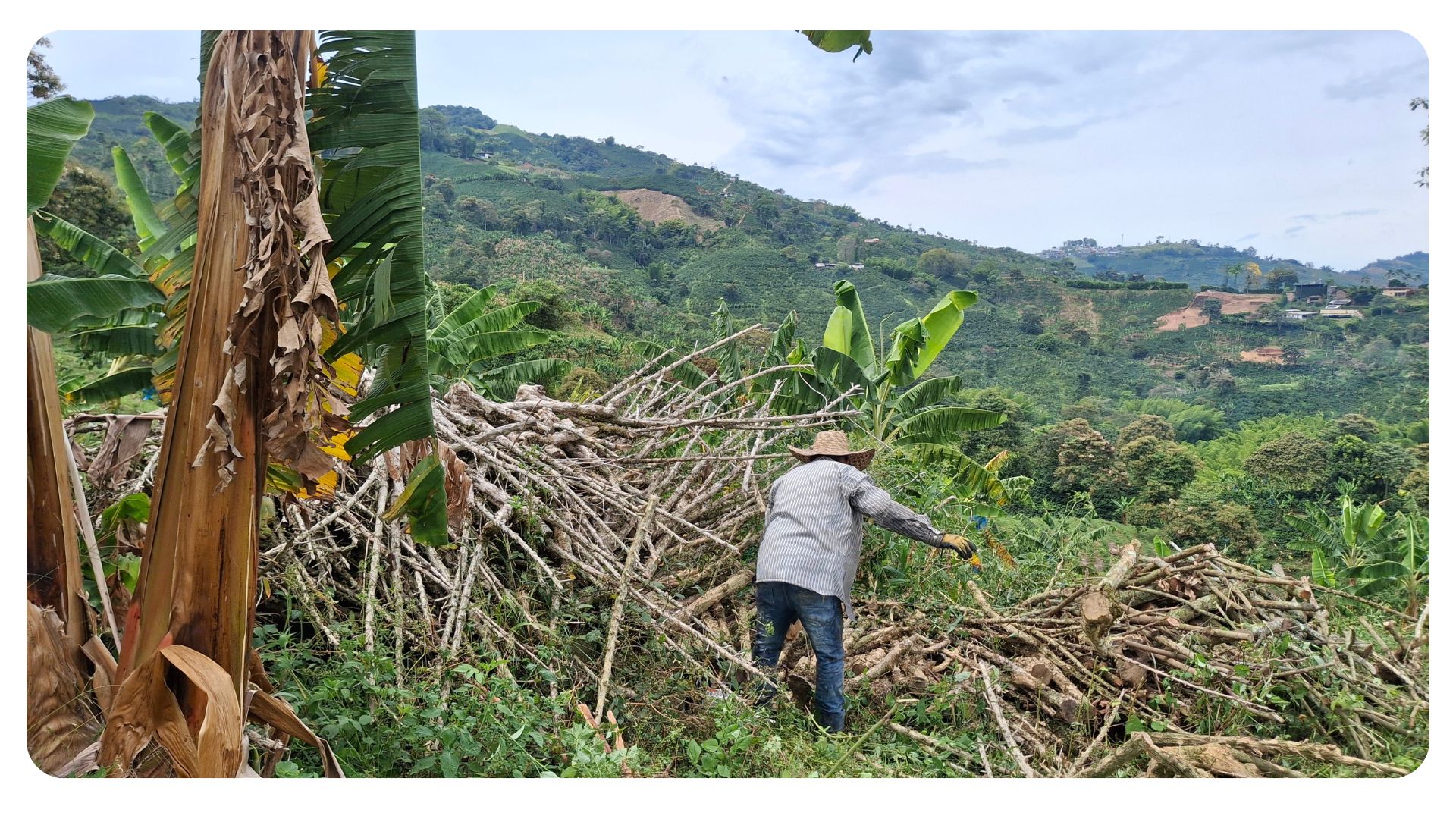 Local farm operator collecting coffee prunings. Photo: Planet2050
Transparent digital verification for global carbon markets: Cotierra operates under the Artisan C-Sink standard certified by Carbon Standards International, with plans to transition to methodologies like Isometric by 2027. To ensure data integrity in remote areas, Cotierra uses an offline-first digital MRV pipeline:
"We conduct hands-on, 1-on-1 training on every farm. Operators log every burn, record moisture levels, and take geotagged photos using the PlantVillage app. Because cell service in the mountains is spotty, the app works completely offline and automatically syncs data to central databases once operators reach connectivity in town."
— Cristian Franco, Zone Representative, Eje Cafetero
Why this approach signals an exciting direction for carbon finance
With 800 registered farms across four Colombian regions and 200 actively producing biochar, Cotierra demonstrates how carbon finance can scale rapidly within agricultural supply chains.
At Planet2050, we see this project as a promising example of three fundamental principles in carbon removal:
Embedded integration: Seamlessly woven into critical agri-food commodity value chains.
High quality: Durable, science-backed CO2 removal verified by digital MRV (dMRV).
Tangible co-benefits: Enhanced soil fertility, reduced reliance on synthetic fertilizers, and cleaner local air.
Equitable value distribution: Direct financial payouts designed to meaningfully strengthen rural livelihoods.
Our Perspective
At Planet2050, we are convinced: For the carbon market to be credible, it above all needs measurable impact (quality) and transparency. As shown by the Cotierra example, such climate projects exist. These are the projects that need to be made visible to explain today's carbon market. This creates a market that benefits investors, the climate, and local communities alike. That is our mission.
____
Stay ahead of the market
Running a CDR climate project and seeking a financier? Apply here!
Subscribe to our newsletter to receive exclusive deployment updates, regulatory insights, and climate asset opportunities straight to your inbox.