


Companies can cut most of their emissions, but not all of them. What remains after far-reaching efficiency measures and the switch to clean energy has to be removed from the atmosphere.
Until recently, buying carbon removals was a decision made by a handful of pioneers, most of them from Big Tech. Today, regulators and the organisations that set climate requirements for companies are increasingly writing carbon removal directly into their rules.
Key takeaways
Net Zero targets cannot be reached without carbon removals, because remaining residual emissions must be neutralised.
Certifications and standards such as SBTi V2.0 and the EU CRCF now create a formal framework for the use of carbon removals.
Novel carbon removals made up only about five percent of retired carbon credits in 2025. This shows the market's growth potential.
It is not the "removal" label that decides whether a credit holds its value, but its quality.
From voluntary to hybrid carbon markets
Carbon markets, in which a tonne of CO2 is given a price, come in three forms:
In a Compliance Carbon Market such as the EU Emissions Trading System, a regulator caps total emissions and issues a limited number of allowances. Companies can only buy or sell rights that have already been allocated. This keeps the maximum total volume of emissions capped, regardless of how allowances are traded.
In the Voluntary Carbon Market (VCM), companies purchase verified carbon credits. Each credit represents one tonne of CO2-equivalent whose emission has been avoided by a project or removed from the atmosphere. The actual removal is regularly audited by an independent standard.
The Hybrid Carbon Markets: this third form is now emerging. Credits generated under voluntary standards can increasingly also be used within regulated systems. This links the two markets and creates regulation-driven demand for credits from climate projects that avoid emisisons or remove carbon dioxide.
This article deals mainly with the second and third forms, and with why carbon removals are becoming ever more important in both.
What are carbon removals?
A carbon removal (Carbon Dioxide Removal, in short "CDR") is any activity that takes CO2 out of the atmosphere and stores it for the long term.
This can happen through natural processes, for example through forests or the restoration of peatlands, or through technologies such as biochar, Direct Air Capture (DAC), or capturing CO2 from biomass and storing it underground (BioCCS).
While emission reductions prevent CO2 from entering the atmosphere in the first place – for example by destroying methane at landfills or preventing deforestation – carbon removals aim to actively take out CO2 that is already in the atmosphere.
Carbon markets count ONLY additional, human-induced removals, not the CO2 the planet already absorbs on its own.
.jpg) Examples of carbon removal methods.
Examples of carbon removal methods.
Carbon removals are becoming a structural necessity
Three forces are driving this shift:
Science determines the size of the removals required.
Net Zero targets and standards such as SBTi or ISO 14068 define the timeframe.
Regulation creates the first mandatory demand.
Together, these three forces transform carbon removals away from the voluntary carbon markets and into an asset class with limited supply and a clearly defined group of buyers.
The thesis is not that removals are better than emission reductions. An analysis by Calyx Global makes the point clearly: a tonne of CO2 avoided and a tonne of CO2 removed have exactly the same effect on the atmosphere, and quality varies just as widely within both categories.
The argument here is narrower and, precisely for that reason, stronger. For the emissions that remain once all other measures have been exhausted, removals are the only available tool. That turns them from an optional investment into a necessary one.
Unfortunately, there is still far too little capital for the early phases of climate projects to produce carbon removal certificates in the required quality and quantity.
1,750 times more engineered carbon removals are needed
Human activity currently causes around 42 billion tonnes of CO2 emissions per year. At the same time, roughly 2.2 billion tonnes of CO2 are removed.
To limit warming to 1.5 degrees by 2100, the annual volume of carbon removals must rise to around 8.75 billion tonnes by 2050. That is a quadrupling compared with today.
.jpg) Chart: Required growth in carbon removals to 2050.
Chart: Required growth in carbon removals to 2050.
It is not only about the total volume to be removed, but also about the share of engineered methods within it. Today, that share is just 0.1 percent. In Paris-compatible scenarios, it reaches around 40 percent by 2050 (State of Carbon Dioxide Removal).
Nature-based removals are cheaper and quick to scale.
But removal methods must be matched to the lifetime of the gases they are meant to take out of the atmosphere. Neutralisation requires durable storage: decades to thousands of years. Engineered removal methods such as biochar, Direct Air Capture and BECCS can deliver this.
To meet climate targets, 3.5 billion tonnes per year must be removed by 2050 through engineered, durable methods alone. That corresponds to a scale-up of roughly 1,750 times within a single generation.
.jpg) Chart: Scale-up of engineered carbon removals.
Chart: Scale-up of engineered carbon removals.
Closing this gap would require engineered carbon removals to grow at a pace comparable to that of solar power and electric vehicles – only faster.
This calls for decades of investment in CDR projects, set in motion today by paid demand for certificates.
Why companies must increase their carbon removal budgets
The climate crisis alone is not enough
Knowing that the world is in a climate crisis is not enough to change markets. Economic incentives, corporate reputation, public pressure, standards and regulation are increasingly driving demand.
New requirements are changing the carbon market
The Science Based Targets initiative (SBTi) publishes the world's most widely used framework for corporate climate targets. Its revised Corporate Net Zero Standard V2.0, finalised in June 2026, fundamentally changes the role of carbon removals.
The standard introduces the concept of Ongoing Emissions Responsibility, under which companies must take responsibility for the emissions they continue to cause on the road to Net Zero.
From 2035, carbon removals become mandatory for large companies: initially for at least one percent of ongoing emissions, with a rising share of durable removals. By the Net Zero target year, the share rises to 100 percent of the remaining residual emissions. This sets a binding timetable.
The different ways carbon credits can be used are summarised as follows:
.jpg) Chart: Use of carbon credits under SBTi CNZ V2. Source: Planet2050, based on data from The Nature Conservancy, 2026.
Chart: Use of carbon credits under SBTi CNZ V2. Source: Planet2050, based on data from The Nature Conservancy, 2026.
Addressing historical emissions
Optional, but encouraged.Companies may finance carbon removals or high-quality avoidance credits to take responsibility for emissions released before their base year. This is recognised, but not counted towards a climate target.
Addressing ongoing emissions
Optional at first, mandatory for large companies from 2035.While companies pursue their reduction pathway, they should additionally finance climate mitigation outside their own value chain, in proportion to their not-yet-avoided emissions. Both avoidance and removal credits are permitted; from 2035, only removals.
Covering a target shortfall
Optional, new in V2.0.If a reduction target is missed, the gap can be addressed with removals or high-quality avoidance credits equal to the shortfall. This is recognised as accountability for the missed volume, not as meeting the target.
Neutralising residual emissions
MandatoryEven if a company reduces its emissions by 90 percent or more, unavoidable residual emissions remain. These must be neutralised with durable carbon removals. Only credits from removal projects are eligible – with a steadily increasing share of long-lived storage methods until the Net Zero target year and beyond.
Thousands of companies have had their climate targets officially reviewed and validated by SBTi. Every company with a validated Net Zero target now faces a clear timetable for buying carbon removals.
This is the strongest single driver of future demand in the voluntary carbon markets: a scientific recommendation becomes a strategic obligation for corporate leadership, with fixed deadlines.
Standards such as SBTi's thus transform carbon removals from a discretionary corporate expense into a core operational obligation – and create a stable foundation for long-term market growth.
The regulators have acted
The European Union has created the first binding framework for carbon removals. The Carbon Removal and Carbon Farming Regulation (CRCF), in force since December 2024, defines EU-wide certification rules for permanent carbon removal, carbon farming and carbon storage in products.
With the first delegated acts on certification methodologies, adopted in February 2026, the framework is now becoming operational.
Certificates issued under the CRCF can initially be used for public and voluntary purposes. In a second step, they are to be admitted for meeting legal requirements in regulated markets.
.jpg) Chart: Carbon removal methods in the EU certification framework (CRCF).
Chart: Carbon removal methods in the EU certification framework (CRCF).
In July 2026, the European Commission proposed formally integrating permanent carbon removals into the EU Emissions Trading System (EU ETS), the world's largest regulated carbon market.
.jpg) Chart: Simplified representation of the integration of carbon removal certificates into the EU ETS.
Chart: Simplified representation of the integration of carbon removal certificates into the EU ETS.
Read: From niche market to billion-euro opportunity: integrating permanent CDR into the EU ETS
The methods that qualify are primarily engineered storage solutions such as BECCS (bioenergy with carbon capture) and DACCS (direct air capture with storage). For the period from 2031 to 2040, this is expected to create a market worth up to 50 billion euros.
The direction is clear: compliance buyers in Europe will be paying for carbon removals within this decade.
The market is still young but growing fast
The gap between future obligation and current supply is considerable. According to Carbon Direct, carbon removals accounted for only about five percent of retired credits in 2025, although the forward market is considerably more active.
In forward deals, buyers commit today to take delivery of CO2 volumes in the coming years, mainly through "offtake" contract, similar to Power-Purchase-Agreement in solar or wind projects. They contract at a price set now, but mainly pay later (at delivery).
In 2025, offtake and forward agreements worth 13.7 billion US dollars were announced, more than 14 times the value of credits actually retired on the spot market (Sylvera, Carbon Market Trends, July 2026). This applies across all carbon credit types, but it is particularly pronounced for novel, engineered removals, because these contracts mostly finance projects that do not yet exist today.
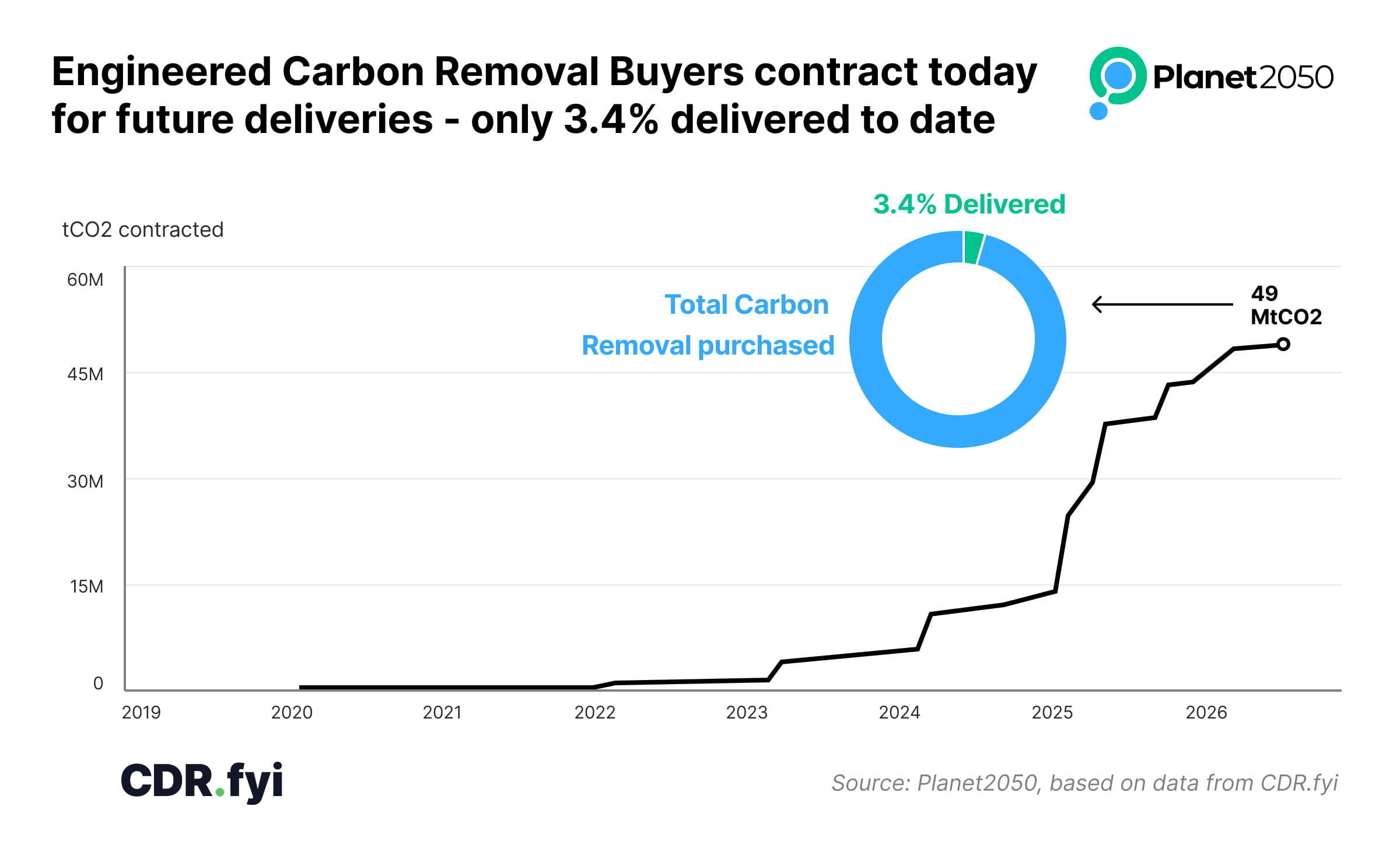 Chart: Growth of the durable carbon removal market since 2020, in millions of contracted tCO2. The donut shows the current delivery rate of 3.4%.
Demand is currently concentrated among a few large buyers such as Microsoft, Google, JPMorgan, Airbus, Amazon, Boeing, Stripe, Shopify and Swiss Re.
These companies are among the pioneers – the few percent of players that have already acted.
That is exactly where the opportunity lies: every company with an SBTi target and every EU ETS participant is a potential future buyer.
Price signals
Removal prices span a wide range.
Biochar credits trade at roughly 110 to 400 euros per tonne on registries such as Puro.earth, Isometric or Rainbow, while Direct Air Capture credits can cost 400 to 1,000 euros per tonne. At the other end of the scale, emission reduction credits for super pollutants such as landfill methane sell for 10 to 40 euros per tonne.
Companies with limited budgets will therefore prioritize reductions today and shift towards removals over time, if they have the options between both.
This is exactly the transition described by the Oxford Offsetting Principles – a set of guidelines designed to align carbon offsetting with Net Zero goals. The share of removals in corporate portfolios rises as their costs fall and deadlines approach.
Google's approach with a growing share of carbon removals
Google is a practical example of this combined approach. Its "warming neutralisation" portfolio allows different credit types to be used across different time horizons.
Eliminating super pollutants slows warming almost immediately, but loses its effect as those short-lived gases decay.
Nature-based removals deliver cooling over the coming decades.
Durable removals are the only category that permanently returns the atmosphere towards pre-industrial conditions.
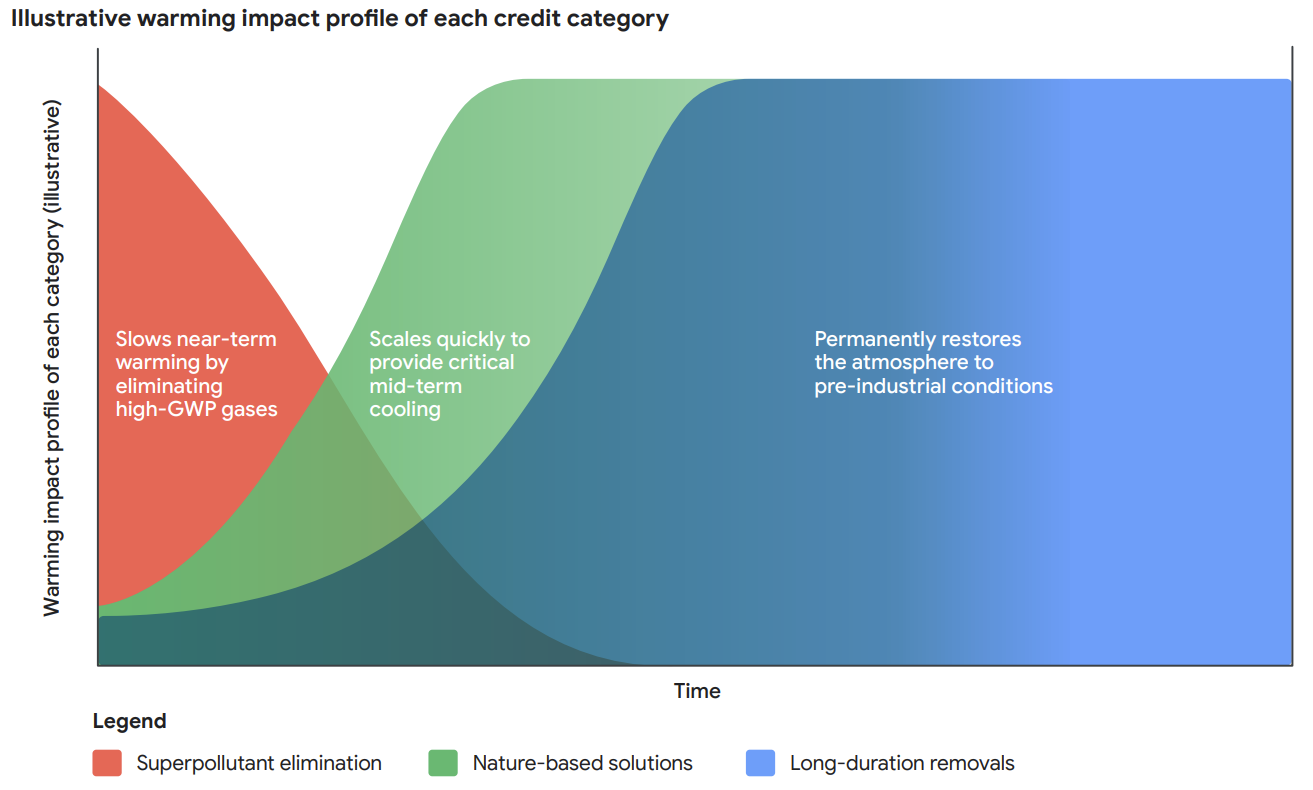 Chart: Warming impact profile of different carbon credit types, from Google Environmental Report 2026.
Google has therefore steadily increased its share of durable removals. This includes an agreement for 200,000 tonnes of biochar credits in March 2026.
At the same time, Google intends to replace its credits for particularly harmful short-lived gases with longer-lived credits as their effect expires. The portfolio starts with fast, affordable action and evolves towards permanent carbon removals. Many more companies are likely to follow this path.
Why this matters for investors
The development resembles the early markets for wind and solar power, in which a few large technology companies signed the first contracts. Those contracts created a template, lowered financing costs and drew in a second generation of buyers.
A similar development is now taking shape, with one decisive difference: this time, regulation is accelerating the second wave of growth.
For retail and institutional investors, the investable layer lies in the infrastructure and in the contracts rather than in individual credits.
Carbon Finance means providing capital to projects in exchange for a share of the credits they will produce in the future.
Carbon Assets are the resulting rights to Verified Carbon Credits – credits that have been audited and issued by an independent standard.
A company that holds a portfolio of such rights benefits from the demand shift described above without having to operate a single plant.
Conclusion
Carbon removals are increasingly becoming mandatory. Not because they are superior to emission reductions, but because there is no other solution for remaining emissions.
SBTi V2.0 sets the timetable for companies, while the CRCF and the EU ETS proposal create the first regulatory demand in Europe.
Removal credits today make up only around five percent of all retired carbon credits, and demand depends heavily on a small group of large buyers.
It is precisely in this gap between a growing obligation and a limited supply that Carbon Finance earns its return.
_____
Follow the demand before it emerges
If you want to understand how Planet2050 turns demand for carbon removals into Carbon Assets, subscribe to the Planet2050 Atlas newsletter.