


Europe’s carbon market is preparing for its next big step. For the first time, the EU is formally discussing how to bring carbon dioxide removals into the Emissions Trading System (EU ETS), the world’s most important compliance carbon market. We wrote about the proposition here.
The article now presents where the debate stands as of October 15th, as negotiations get underway.
The Commission’s proposal
In July, the European Commission proposed raising the ETS cap by 250 million allowances. It would auction them between 2031 and 2040 and use the revenue to buy an equivalent amount of permanent removals: bioenergy with carbon capture and storage (BioCCS) and direct air capture and storage (DACCS). Companies that produce certified BioCCS removals at their own sites could also use them directly against their fossil emissions.
Measured against today’s market, the scale is significant. The durable removals industry has delivered just over 1.6 million tonnes to date, which makes the planned purchase of 250 million tonnes a step change.
The 250 million figure comes with caveats, however. The proposal commits to auctioning the allowances, but it does not guarantee that 250 million tonnes of removals will actually be purchased or delivered.
The proposal also excludes biochar, a method of permanent carbon removal, even though it has a certification methodology under the EU’s Carbon Removal Certification Framework (CRCF).
Parliament: a push for more, and a push for limits
Peter Liese (EPP), the European Parliament’s lead rapporteur on the file, wants to move faster.
His draft report keeps the 250 million tonne target, adds funding, and proposes allowing removals into the ETS from 2029, with biochar accounting for up to 20% of removal credits.
That would open the door to one of the most scalable and cost-effective permanent removal methods available today.
The amendments tabled by the other groups, first reported by Contexte, show how far apart the positions are:
That would open the door to one of the most scalable and cost-effective permanent removal methods available today.
The amendments tabled by the other groups, first reported by Contexte, show how far apart the positions are:
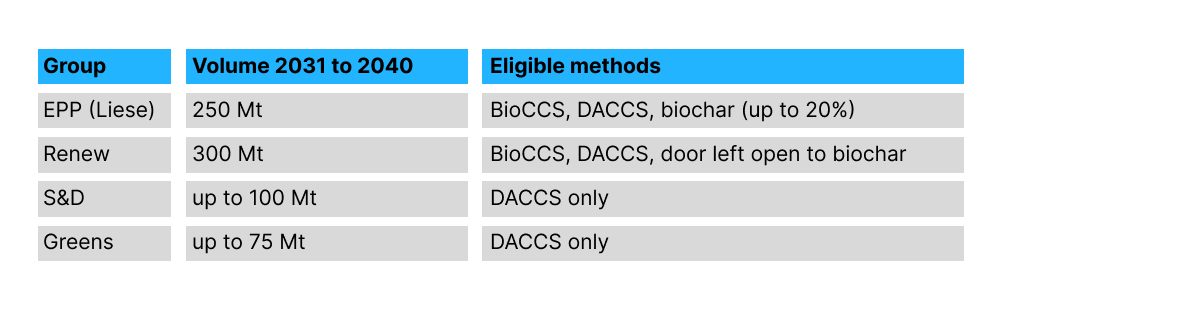
Renew stands out as the most ambitious, proposing to raise the volume to 300 Mt. S&D and the Greens go the other way.
Besides cutting the volume, both would limit eligibility to direct air capture (DACCS) and delete the clause allowing ETS operators with biogenic emissions to count their own BioCCS removals. At those levels, industry observers estimate that removals would make up less than 2% of ETS emissions in the 2030s.
Critics point out that restricting the ETS to DACCS alone would be hard to deliver. DACCS has delivered essentially no removals in the EU so far, installed capacity is estimated at a few thousand tonnes, and current prices range from around €500 to €1,000 per tonne. BioCCS, by contrast, already costs roughly half as much and builds on Europe’s established sustainable biomass rules.
The centre-left groups are also united on international credits: S&D, Renew and the Greens all want them kept out of the ETS.
Industry and NGOs divided
In September, five European carbon removal trade associations, including AFEN (France), DVNE (Germany), the Italian Carbon Removal Network and the Nordic Carbon Removal Association, issued a joint statement supporting integration. AFEN is also pushing to expand the eligible methods beyond BioCCS and DACCS.
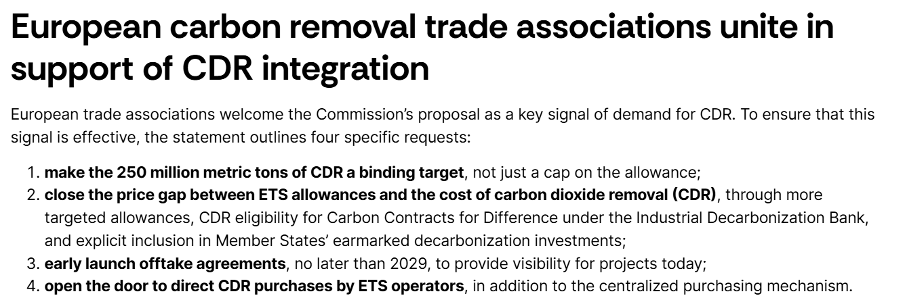 Excerpt from a joint statement from European carbon associations. Source: AFEN.
On the other side, WWF has urged lawmakers to reject integration. Its position statement warns that the plan would expand the supply of pollution permits and weaken incentives to cut industrial emissions.
Others take a middle path. The Clean Air Task Force (CATF) recommends a careful, gradual integration with strong safeguards, so that emission reductions are not displaced.
What comes next
EU environment ministers have held a policy debate on the ETS review on Monday 12 October. There, all 27 ministers backed the ETS as a core tool for decarbonization and industrial competitiveness, but deep divisions emerged over the speed of emission cuts, industry supports, and rules around free allocations
Next, the Irish Council Presidency is preparing its first compromise text on the integration of Removals. A final agreement is targeted for the first quarter of 2027.
Watch now: Planet2050’s CEO Lucas Zaehringer on Carbon as an Asset Class
Why it matters
Whatever the final design, the direction is clear: permanent carbon removals are becoming part of Europe’s core climate infrastructure.
A compliance-funded buyer for removals would give project developers and investors the long-term demand signal this market has lacked.
The key open questions are volume, eligibility and timing: How much will actually be purchased? Will biochar be included? Will demand start in 2029 or 2031?
The answers will shape where capital flows in the next decade. At Planet2050, we are following the negotiations closely and will keep you updated as the file moves forward.
_____
Stay ahead of the market
Want to follow how this new demand reshapes the market for carbon removal? Subscribe to the Planet2050 newsletter.