Take the Planet2050 survey - Your view on carbon as an asset class - plus a prize draw
Take the Planet2050 survey - Your view on carbon as an asset class - plus a prize draw


Reading Time: 5min

The Carbon Business Council (CO2BC) released a landmark report: "Latin America carbon dioxide removal investment roadmap." This strategic resource provides a blueprint for Latin America, as the premier geography for global high-integrity carbon removal, and a key region for closing the global emissions gap.
Summary
CDR is essential to close the 24-27 gigatonne emissions gap by 2050.
Latin America's 25% global forest area makes it ideal for global CDR solutions.
Scaling is blocked by a "circular financial straitjacket," as market mechanisms are insufficient.
The financing gap requires deliberate risk allocation, targeted policy, and blended finance structures.
CDR is essential to achieve the 2050 net-zero targets, as reduction measures alone are not sufficient to compensate for remaining emissions from hard-to-abate sectors.
The Climate Action Tracker shows that the emissions gap consistent with a 1.5°C pathway is 24 to 27 gigatonnes of CO2 equivalent per year.
With 25% of the world's forest areas and productive agricultural and mining land, Latin America is uniquely positioned to meet the demand for permanent CO2 removals. The report emphasizes that success requires tailored solutions: Without deliberate risk allocation, targeted policy support, and adapted capital structures, market mechanisms alone cannot enable sustainable deployment.
The roadmap is the result of an eight-month structured dialogue by the Latin America Carbon Removal Working Group, convened by the Carbon Business Council. The group brings together developers, financial institutions, companies, and experts from across the value chain. Key contributors include BBVA, Boomitra, Carbonfuture, Cercarbono, Exomad Green, Future Climate Group, Howden, InPlanet, KfW, Kita Earth, Mitsubishi Corporation do Brasil, Mombak, Remove, Silica, and Tierra Prieta.
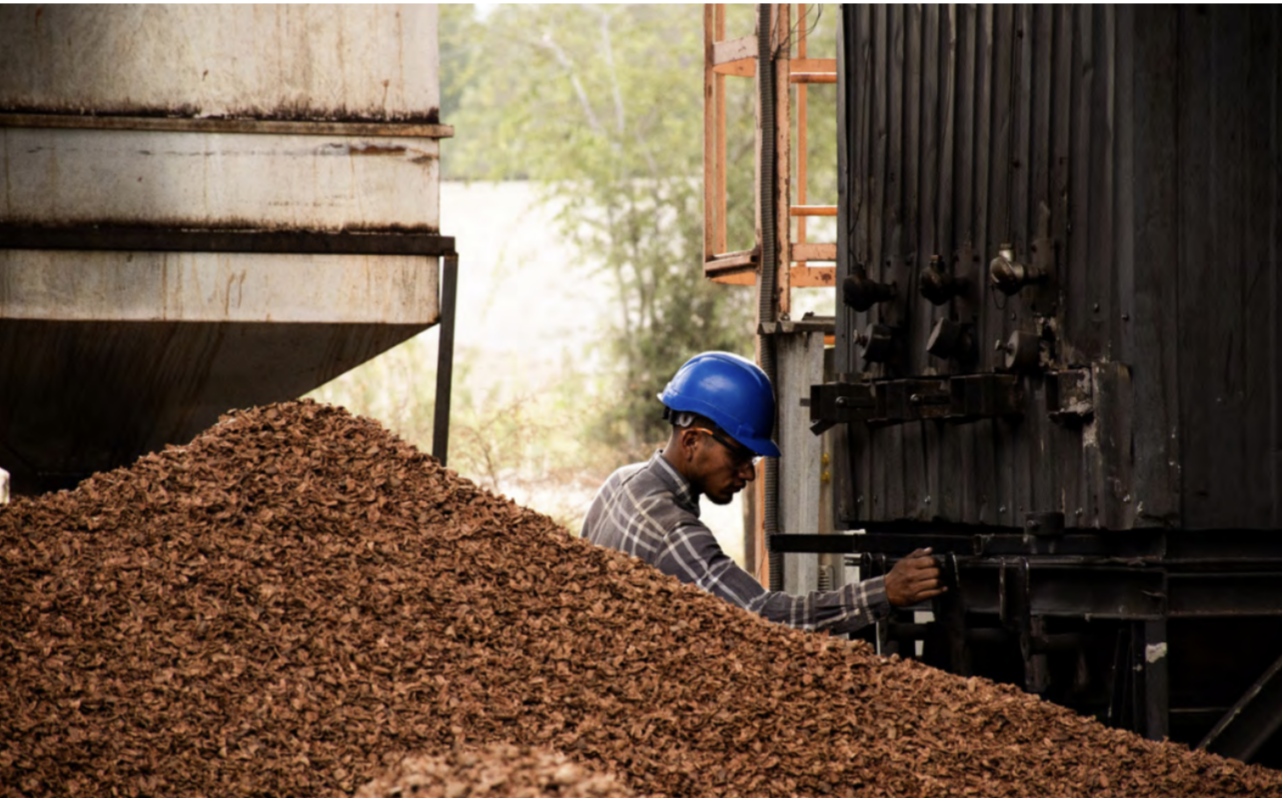 Operator on biochar carbon removal site (Photo: Carbon Business Council)
The central hurdle for scaling CDR in Latin America is financial, not technical. There is a "circular financial straitjacket" blocking growth despite technical readiness: Buyers are waiting for policy; banks are waiting for contractually secured revenue; developers are waiting for capital; and governments are waiting for market evidence.
To break this vicious cycle, the report calls for a deliberate financial architecture focused on blended finance and revenue certainty through multi-year off-take agreements.
The CO2BC Working Group identified six fundamental realities determining the roadmap:
Reliable demand and revenue certainty are crucial for the bankability of projects, which currently depend on a thin market of voluntary buyers.
The key barrier is financial, as projects are often too large for early-stage equity but too risky for traditional banks ("valley of death").
A sequenced capital structure (e.g., catalytic capital) is necessary to absorb early risks before commercial banks step in.
Public policy and finance must create targeted instruments such as public procurement and reverse auctions for early-stage de-risking.
Independently verified data infrastructure (dMRV) is essential to lower the perceived risk for investors and reduce project costs.
Structurally higher capital costs in Latin America require credit enhancement mechanisms, e.g., first-loss guarantees from Multilateral Development Banks (MDBs), to protect private investors from regional macro-shocks.
In Latin America, nature- and technology-based CDR solutions like biochar and Enhanced Rock Weathering (ERW) dominate.
The region can become the gold standard in these areas:
Biomass-based removals (biochar, BECCS) utilize the region's extensive agricultural residues.
Geochemical removals (Enhanced Rock Weathering (ERW)) utilize geology and the mining sector to accelerate natural rock weathering.
High-integrity nature-based solutions (afforestation, blue carbon) focus on verifiable storage in the Amazon and along the coasts.
The roadmap aims for three flagship projects by 2030, intended to serve as proof-of-concept for global lenders:
Amazon basin: Focus on high-integrity afforestation and soil carbon.
Andes: Focus on mineralization and geothermally powered removals.
Southern cone: Scaling of biochar and agricultural Enhanced Rock Weathering (ERW).
The institutional building blocks are in place, e.g., global buyer clubs like South Pole’s TechGen, are already procuring high-durability removals from Latin America.
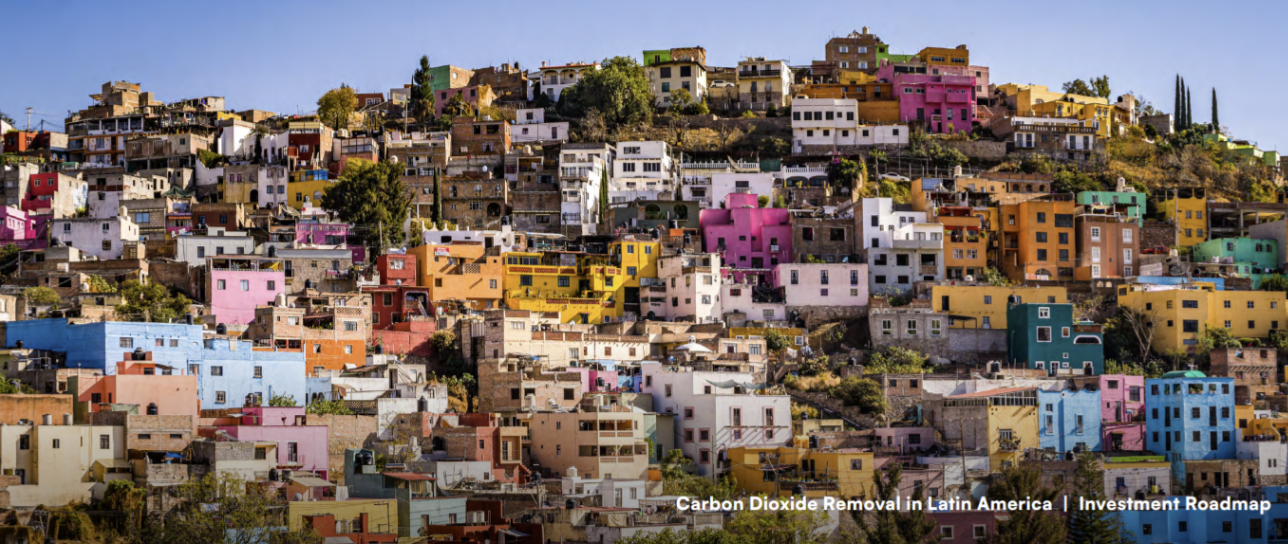 Colorful Hillside Buildings in Guanajuato, Mexico. (Photo: Carbon Business Council)
Latin American projects are already securing high-volume, multi-year off-take agreements from investment-grade partners.
Bolivia: Exomad Green operates the world's largest biochar plant and has secured a 10-year contract for 1.24 million tonnes with Microsoft.
Brazil: Mombak has raised over 200 million US dollars and completed 150 million US dollars in off-take agreements with Google, Microsoft, and Meta. InPlanet leads the country's Enhanced Rock Weathering (ERW) efforts.
Mexico: Tierra Prieta manages an industrial-scale biochar facility certified by Puro.earth, while Boomitra has issued a record 3.03 million Verra-verified soil carbon credits across four million acres of grassland. Additionally, Silica is pioneering novel agricultural measurement techniques through volcanic rock application (ERW).
The report also highlights five focus countries - Brazil, Mexico, Colombia, Peru, and Chile - representing the five markets central to the regional CDR landscape, with Brazil scoring the highest points.
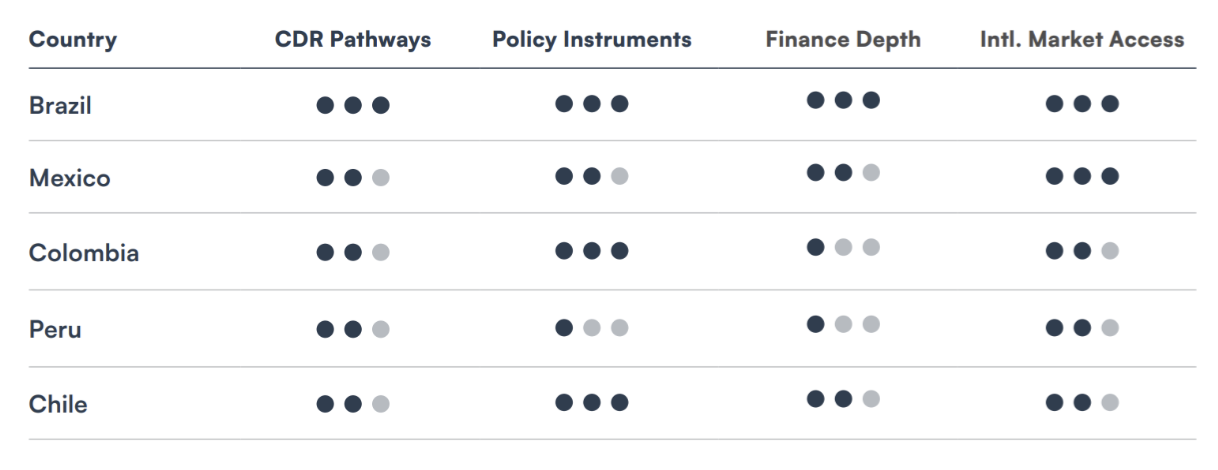 CDR Focus Countries in Latin America (Source: Carbon Business Council)
Policy is moving toward stronger recognition of CO2 removals. Brazil is integrating removals into its emissions trading system (SBCE), Chile officially identifies BECCS and DAC as core instruments, and Colombia/Mexico are building corresponding frameworks.
Latin America has the natural assets; Planet2050 creates the financial architecture to realize the global carbon removal potential.
Planet2050 is operationalizing the roadmap by building the digital financial architecture to overcome the "systemic impasse." This is achieved through three strategic pillars:
CDR RFP & procurement: Providing demand certainty by connecting Latin American projects with global buyers.
Pre-financing: Enabling catalytic capital to bring projects to senior-debt maturity.
dMRV BioCarbon Standard Working Group: Building data integrity and transparency for institutional scaling.
Latin America has the natural assets; Planet2050 creates the financial architecture to realize the global carbon removal potential.
Read the full report "Carbon Dioxide Removal in Latin America" here
 The famous Escadaria Selaron staircase in Rio de Janeiro is made of colorful ceramic tiles from all over the world. (Photo: Report “Carbon Dioxide Removal in Latin America”)
_____
Investor Updates: Sign up on our Investor Page to stay informed on our upcoming listing.
Onboard your own project here.