


In the world of climate action, not all carbon credits are created equal but not everyone understands why. Carbon Credits representing 1 tonne of CO2 equivalent avoided or removed can be worth from 1 to 1000€. Why does this gap exist? It isn’t just market volatility - it’s a reflection of technology, permanence, and trust. Here is a breakdown of what actually drives the price of a carbon certificate.
Summary
Not all carbon credits are equal: the price of 1 tonne of CO₂ can range from €1 to €1,000 depending on the project.
The method drives the price: avoidance credits are usually cheaper, while technical removals like DAC or biochar command much higher prices.
Permanence creates a premium: the longer CO₂ stays out of the atmosphere, the more valuable the credit becomes.
Quality, trust, and financing matter: ratings, insurance, compliance eligibility, and early offtake agreements all push prices higher.
For Planet2050, the key point is: the market rewards not the cheapest credit, but the strongest mix of quality, durability, and risk protection.
1. Avoidance vs. Removal: The Method Matters
Avoidance (approx. €1–€30)
These projects focus on preventing emissions that would have happened. Think of wind farms or forest conservation (REDD+). They are relatively cheap to scale but often face scrutiny regarding "additionality"—the proof that the project wouldn't have happened anyway without the carbon funding.
Technical Removal (up to €1,000)
This is the "high-tech" end of the spectrum. Technologies like Direct Air Capture (DAC) act like giant vacuums, pulling CO2 directly from the sky to store it underground. Methods like Biochar lock carbon into the soil for centuries. Because these technologies are in their infancy, the "first-of-a-kind" costs are high, but they are essential for reaching true Net Zero.
2. The Permanence Premium
In the carbon market, time is literally money. The longer you can guarantee the CO2 stays out of the atmosphere, the more you pay:
Short-term (Nature-based): Trees are vital, but they can burn or rot, releasing carbon back into the air within decades.
Long-term (Geological): Injecting CO2 into rock formations or mineralizing it offers a guarantee of 1,000+ years. This high level of "permanence" commands a significant premium.
3. Quality and "Co-Benefits"
A certificate is often more than just a metric ton of gas. Prices rise when projects provide additional value, such as:
Biodiversity: Protecting an ecosystem that is home to endangered species
Social Impact: Supporting local communities with jobs or clean water
Compliance Labels: Credits approved for regulated markets (like CORSIA for aviation) naturally cost more due to strict oversight
Local Sourcing: Companies often pay a premium for local carbon credits to achieve maximum credibility through regional proximity - even when domestic project costs are significantly higher than international alternatives.
4. Assurance Factors
Modern pricing now reflects advanced project methodologies, external carbon ratings, and even non-delivery carbon insurance to protect against project failures. Carton Rating agency BeZero Carbon found that projects rated in the three highest notches of its rating scale delivered credits with a price premium of roughly 80% higher than credits with a lower rating.
5. Financing & Volume: How You Buy Matters
Beyond the specific attributes of a project, the financial terms themselves dictate the price:
Spot vs. Forward: Is the credit purchased "Spot" (available immediately at current market rates) or as a "Forward"? Buyers and Investors who enter early and share the development risk with the project owner often secure future credits at significantly lower prices.
Volume: As with any commodity, scale matters. Large-scale buyers who secure contingents over several years achieve entirely different nominal prices compared to those purchasing small retail quantities.
According to Sylvera in its latest State of Carbon Credit report, Forward offtake market surged to US$12.3 billion, more than 12x spot market value.
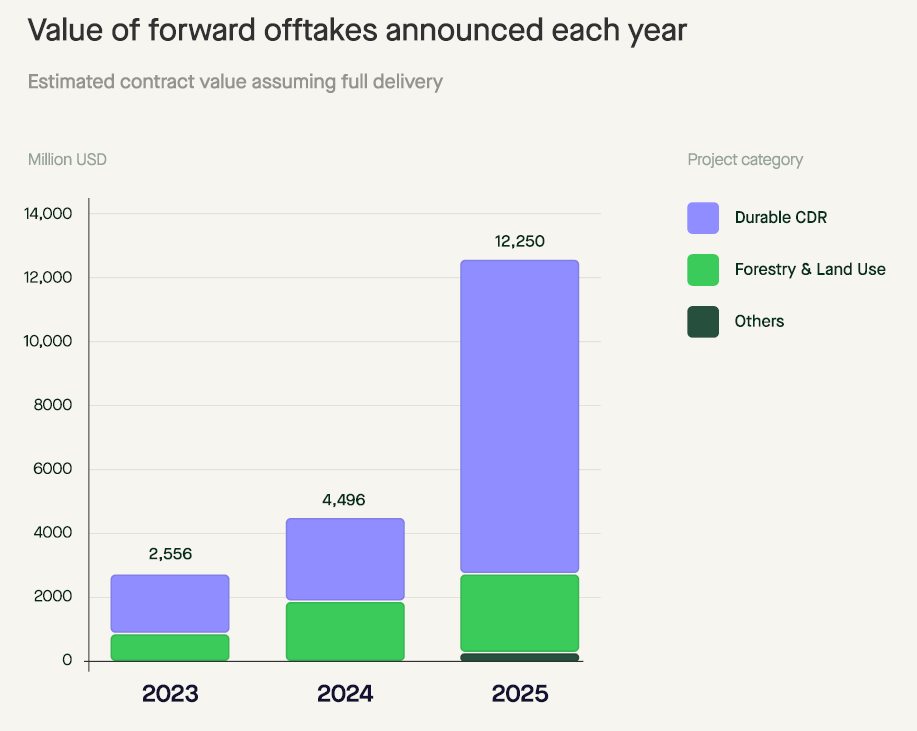 State of the Carbon Market 2025 (Source: Sylvera)
Planet2050’s Role in an Evolving Market
The carbon market is often criticized for being the "Wild West" of finance - complex, opaque, and risky. At Planet2050, we turn this science into a transparent investment asset class open for private investors. We don't just pick projects; we vet them against the most rigorous scientific standards and when possible insure our investment against technological, political or environmental risks. Our approach mirrors how professional corporations operate: instead of betting on a single project, we build portfolios that balance high-impact permanence with cost-efficient volume.
The "Catch" for Investors? 💡
Carbon price discrepancies create opportunities for arbitrage: savvy buyers and investors can strategically deploy capital where they achieve the highest quality per euro. Understanding market trends and demand prediction is key to placing the right bets on the right assets.
The Path Forward
The future of the carbon market isn't about finding the cheapest credit; it's about building a portfolio that actually moves the needle on climate change.
_____
Stay ahead of the market
Go to our Investor page and signup to the alerts to receive listing updates.
Check our other news on our Blog or subscribe to Planet2050 at to never miss the most important Carbon Market News.