


J.P. Morgan Asset Management has renamed its investment manager Campbell Global J.P. Morgan Natural Capital. What sounds at first like a routine rebrand is, on closer inspection, a notable signal: one of the world's largest asset managers is explicitly positioning nature as an investment field, on a par with real estate and infrastructure.
Campbell Global has specialised in timberland and sustainable forestry for more than four decades and was acquired by J.P. Morgan Asset Management in 2021. Its mandate now extends beyond classic forestry investments and, according to the company, also covers land, carbon, biodiversity and other nature-related assets.
The platform manages around 1.5 million acres across three continents and oversees roughly $11 billion in assets for institutional investors.
In March 2025 it closed a forestry and climate fund of $1.5 billion. It sits within an alternatives platform managing around $326 billion in total.
Summary
J.P. Morgan renames Campbell Global to J.P. Morgan Natural Capital, establishing nature as an independent asset class.
Combining various revenue streams like timber, energy, and carbon credits creates long-term structurable natural resource businesses.
EU initiatives such as the Nature Credits Roadmap support the transformation of nature and climate protection into investable units.
The success and sustainability of the new asset class depend crucially on strict verification, transparency, and measurability.
Natural capital becomes part of professional investment structures
Natural capital refers to the stock of natural resources such as forests, soils, water and biodiversity, together with the services they provide to the economy and society.
Measuring these values, pricing them and factoring them into investment decisions is nothing new. What is new is the institutional dimension.
Pension funds and insurers do not invest in niches; they invest in asset classes, with professional portfolio management, data infrastructure, risk review and capital strategies spanning decades.
That is exactly what the name J.P. Morgan Natural Capital makes visible.
Nature-related assets are no longer treated solely as a sustainability topic, but as part of institutional allocation.
Large, professional owners can also raise the bar in forestry: better data, longer time horizons and more accountability than fragmented private ownership typically delivers.
A forest is more than a CO2 store
Reading this move purely through the lens of the carbon market falls short. A professionally managed forest is a portfolio of several complementary revenue streams, and carbon is one of them.
Merchantable timber still goes to the sawmill.
Thinnings, storm- and beetle-damaged wood, harvest residues and low-value biomass, long treated as a disposal problem, can be turned into heat, electricity, fuels or biochar.
Biochar locks carbon into a stable product for centuries and improves soils at the same time.
Restoration of degraded land, water management and biodiversity services can form further lines of income.
Carbon credits are added as one layer in this stack, not as its foundation.
The model "buy forest, grow trees, harvest timber, sell credits" thus becomes an integrated natural-resource business: timber plus energy plus carbon plus biochar plus water plus restoration.
Whether J.P. Morgan actually takes this route is open. With 1.5 million acres, the platform certainly has the scale for it.
For investability, this stacking is decisive. A project with several independent cash flows can be structured, hedged and capitalised over the long term.
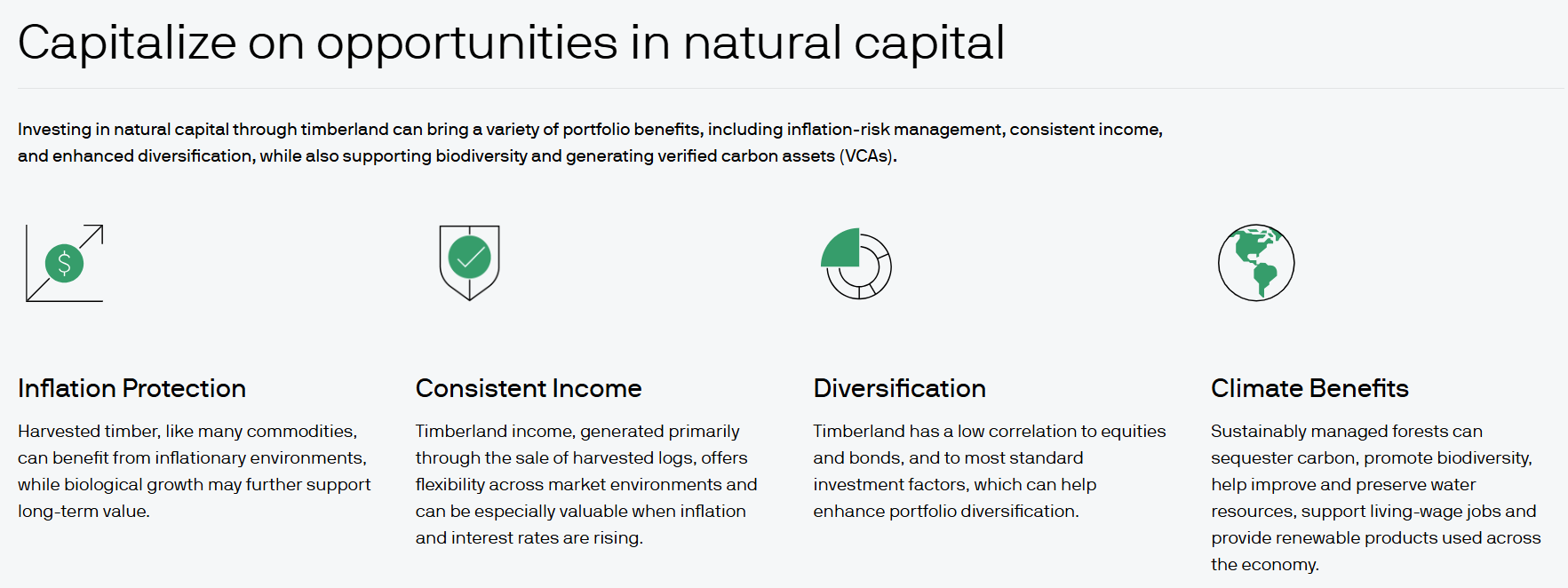 Natural Capital opportunities. Source: J.P.Morgan Asset Management
Brussels, too, wants to turn nature into an asset class
The EU shows that this stacking is also taking regulatory shape.
With its Roadmap towards Nature Credits of July 2025, the Commission wants to turn verified biodiversity outcomes into tradable units, as a complement to public nature funding, not a replacement.
More concretely: the first carbon farming methodologies under the CRCF are due in 2026 to include mandatory biodiversity co-benefits. For the first time within a regulated framework, the same hectare would be certified for both CO2 impact and nature outcomes.
The very assets J.P. Morgan bundles under Natural Capital, forest, soil, water, biodiversity, are the ones this framework addresses.
For now it remains a roadmap: supply and demand are being assessed through 2026, a review follows in 2027, and whether an EU-wide market or national systems emerge is open. But the direction is set, and it supports the model of multiple revenue streams per hectare.
Natural capital and carbon capital are not the same thing
Despite their proximity, the two terms should not be conflated.
Natural capital covers the full economically and socially relevant capacity of nature, from forests and soils to water and biodiversity. Carbon capital, as Planet2050 uses the term, is the part of that field where measurable CO2 reductions or CO2 removals are linked to suitable financing structures. That can mean nature-based projects such as afforestation or mangrove restoration, as well as technological approaches such as biochar or enhanced rock weathering.
What matters is not that a project tells a good story. Climate impact must be quantified, independently verified and durably secured. The Integrity Council for the Voluntary Carbon Market names additionality, permanence, robust quantification, independent verification and the exclusion of double counting among its core criteria.
A rebrand is not yet a market breakthrough
As significant as J.P. Morgan's move is, a new name does not make natural capital an established asset class. The name only works if the substance follows.
Nature-related investments remain demanding. Projects differ considerably in quality, duration, liquidity, measurability and risk. In the carbon market in particular, quality gaps, poor transparency and greenwashing allegations have cost trust in the past.
What this platform, and the asset class as a whole, will have to be measured against:
Forest management: how clearcutting, replanting and chemical use are handled, especially after fires and storms.
Biodiversity: whether managed forests keep habitat and species diversity, or drift toward plantations.
Soil and water: impacts that rarely show up in a carbon number.
Local communities and indigenous rights: who has a voice in how the land is used.
Carbon accounting: baselines, harvest cycles and how long the CO2 actually stays stored.
Independent measurement: certification is the start, verifiable MRV is the goal.
Part of the full picture as well: J.P. Morgan Asset Management withdrew from the Net Zero Asset Managers initiative last year, and the wider group remains among the largest financiers of fossil fuels. That is no reason to dismiss the platform. It is a reason to judge it by results rather than by its name.
Institutional interest is no substitute for due diligence. On the contrary: the more capital flows into the market, the more important robust standards, independent verification, transparent data and professional risk management become.
From the margins toward the capital market
The transition from sustainability topic to investment field does not happen through vocabulary. It happens through projects, data, standards, governance and capital, and through business models that rest on more than one source of revenue.
Capital is not the enemy of nature. Unmeasured capital is.
If the largest asset managers bring the same rigour to forests that they bring to their financial reporting, carbon can become an investable asset class.
That J.P. Morgan now explicitly runs its platform under the name Natural Capital shows where the market can move.
For Planet2050, it confirms the direction: making high-quality climate impact financeable, measurable and accessible to professional capital structures.
Put differently: natural capital describes the larger shift. Carbon capital is the part Planet2050 wants to actively shape.
_____
Stay ahead of the market
Go to our Investor page and signup for the alerts to receive listing updates.
Check our Other news on our Blog or subscribe to Planet2050 at to never miss the most important Carbon Market News.